Aerosud Holdings, founded in 1990 and based in Pretoria, South Africa, manufactures aircraft parts and assemblies for civil and military aviation. It supplies major manufacturers including Airbus, Boeing, and BAE Systems. To remain a trusted supplier to some of the world's largest aerospace companies, Aerosud needs ways of working that keep pace with demand as well as advanced manufacturing.
The challenge: Fixed processes and an overloaded IT team
Aerospace is one of the most heavily regulated industries in the world. Strict processes make compliance easier but change harder, so companies often keep legacy systems for years. At Aerosud, those systems caused misunderstandings about business priorities. Leaders lacked a full view of work in progress, decisions suffered, and poor communication between teams lowered morale.
The problem was most visible in IT services:
- Slow response: the ticketing system logged requests but couldn't manage the flow of work.
- No transparency: the team struggled to set expectations, agree priorities, or escalate issues to the right people.
- Constant pressure: management pushed for more tickets to be processed, and the team couldn't keep up.
Johan Pretorius needed to speed up IT delivery without adding people or cost. He turned to Xuviate to start a journey toward flow management.
What changed
Simple practices doubled IT throughput
The IT team first agreed how to prioritize, using the Eisenhower Matrix to sort work by urgency and importance. Each person then set up a physical Kanban board. Johan gave the team a crash course in Kanban, and a key lesson stuck: more work in progress means longer cycle times. The team set WIP limits on every board, marked blockers, held daily standups, and ran weekly retrospectives using the "5 Whys" to find root causes.
People began "swarming," helping each other finish work instead of starting more. Throughput doubled from 60 to around 120 tickets.
Xuviate's Kanban Bootcamp took the practices further
Physical boards had limits. They couldn't connect to Aerosud's IT systems, and performance was still measured by hand in Excel. Johan also wanted Kanban in more departments. When the COVID-19 pandemic began, Aerosud's engineers joined Xuviate's online Kanban Bootcamp and learned advanced practices such as STATIK, a structured approach to introducing Kanban, and Flight Levels for project alignment. To support these practices with automation and real-time reporting, Aerosud adopted Businessmap.
IT requests flow in automatically
IT now runs several team workflows on one Businessmap board, including user support with separate lanes for standard and critical requests. Through the Businessmap API, every request from Aerosud's IT service desk portal becomes a card with the requester, due date, and priority. An automation fills in the card's details as it arrives. Work moves through three support levels, with a waiting queue that signals when a ticket is escalated. Service level expectations, set by ticket category, show how long each request should take.
IT projects are tracked on a timeline by category, such as servers, desktops, and cloud services. Each project is broken into deliverables and then tasks, so large and small work sit in one place.
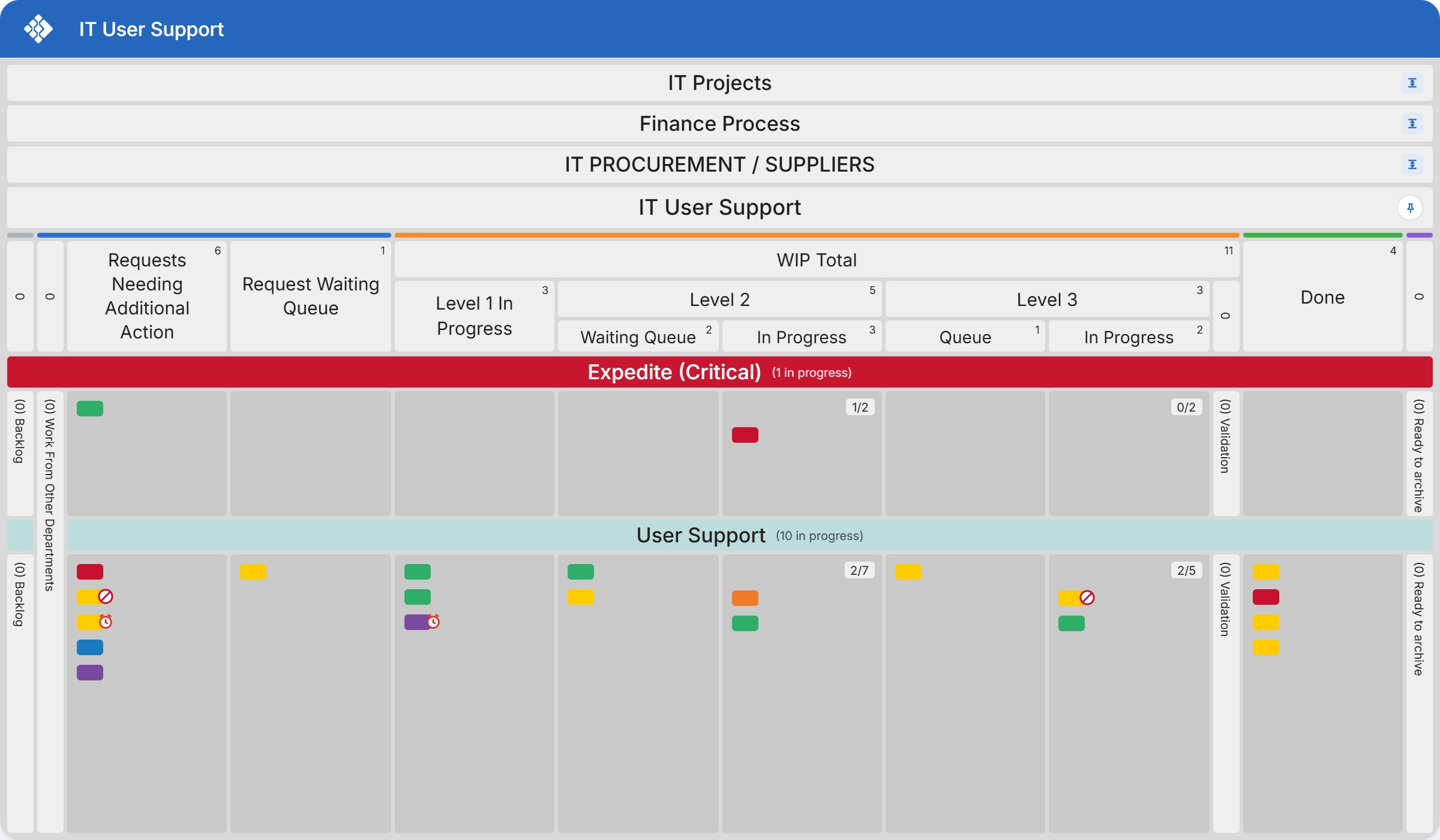 Multiple IT service workflows visualized on a single Businessmap board to improve transparency, prioritization, and coordination
Engineering connected from portfolio to daily work
Next, Aerosud brought flow management to Engineering. After several rounds of refinement, one board now shows the workflows of each service group, including Design, Mechanical, CNC, and Professional Engineering. Each project is broken into work items that move through the relevant team's workflow.
Following Klaus Leopold's Flight Levels model, Aerosud connected three levels of work:
- Industrialization board: top-level project requests from the program office, planned with critical chain planning and imported from Excel onto a timeline.
- Portfolio Workspace: department leaders break each project into departmental deliverables and coordinate them across Engineering, R&D, Production, and Quality.
- Team boards: daily work in Design, Mechanical, CNC, and other areas.
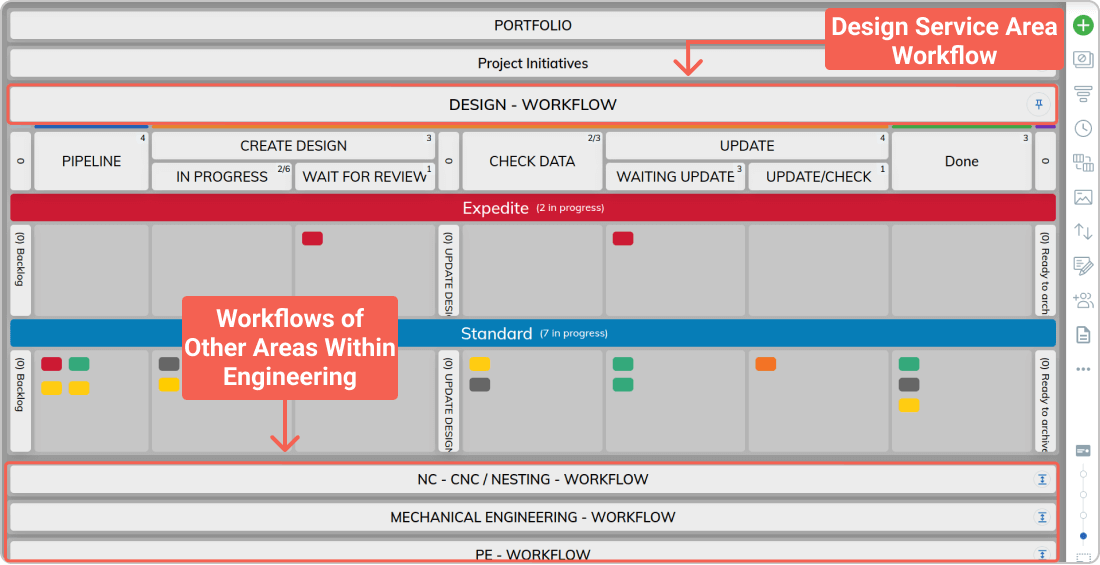 Engineering workflows for Design, Mechanical, CNC, Professional Engineering, and other service groups managed on one shared board
Data and Power BI for capacity planning
The IT team reviews a WIP aging chart at every daily standup, and items past their cycle-time target are flagged for discussion. Flow metrics track work in progress, cycle time, and on-time delivery. The team also logs time and feeds it into Power BI to see weekly capacity per person, and whether people spend their time on support or on projects.
In Engineering, overdue-card reports show projects that started late or missed deadlines. Power BI reports for each service area compare available and allocated capacity, past and future, and let managers drill down to individual blocked items.
The impact: Faster IT delivery and data-driven engineering
Aerosud achieved:
- IT throughput doubled, from 60 to around 120 tickets.
- The 3-day delivery target met consistently, while active work in progress steadily fell.
- One connected structure of boards from project requests to daily engineering work.
- Real-time capacity planning per person in IT and per service area in Engineering.
- Faster decisions, as leaders see where to move capacity for critical projects.
- Data that physical boards couldn't provide, now used to improve planning.
Next, Aerosud plans to add Flight Level 3, connecting business strategy to projects across departments, and to bring Businessmap to more of the company.
Implemented with Xuviate
Xuviate is an international project management consultancy and Businessmap Platinum Partner, based in Germany. It helps industrial manufacturers move from spreadsheets to visual, real-time project and process management, working hands-on alongside their teams. xuviate.com



