The company is a leading global manufacturer of electronic components, with R&D centers and manufacturing sites around the world. In 2019, it acquired a specialized R&D company in Switzerland to strengthen its position in a niche components market. This story follows that R&D division as it built a standard, people-first way of managing product development. It did so with Businessmap and the implementation partner Xuviate.
The challenge: Navigating complexity after strategic growth
Excel couldn’t keep up with a fast-changing R&D portfolio
Transparency shaped the acquisition from the start. Before the deal closed, the future General Manager was asked to build the business case. Instead of a simple yes-or-no recommendation, he ran risk management workshops with the management team. Transparency, involvement, and visualization became the building blocks of how the division would be managed.
After the acquisition, the first priority was a standard approach to project and process management. The division had no formal project management process. The team tracked project charters, goals, and work packages in Excel files. That was transparent, but too static for an environment where priorities changed often. The work itself was complex:
- Different methods: Teams across departments and locations relied on disparate methods and tools, leading to inconsistent project execution.
- Lack of Standardisation: There were no formal project management processes in place. Dependencies between distributed teams often result in delays and misunderstandings.
- Static Tools: Project tracking relied on Excel, which quickly became inefficient for a dynamic, rapidly changing environment.
- Cultural Friction: The integration process brought together teams with vastly different experiences, workflows, and expectations.
- Misaligned Priorities: Strategic goals often get lost in operational bottlenecks without clear visibility, making it difficult to measure progress or allocate resources effectively.
Working with colleagues from another European subsidiary, the project leads introduced a stage-gate process. For the first time, everyone shared one picture of how a product moves from concept to market.
Six months later, a new problem was clear. Status still lived in spreadsheets, so managers spent most of their time interrupting people for updates and typing them into Excel. As one manager put it, "It’s a HUGE WASTE OF TIME." Estimates were also unreliable: tasks routinely took far longer than planned.
The division needed real-time visual status, work packages broken down across several levels, and visible dependencies between teams. It also had a second concern: protecting the agile start-up culture that large acquisitions often disrupt.
What changed
One platform for projects and processes
After several months of assessment, the division chose Businessmap as its project and engineering process management platform. It gave every team a real-time view of status, work packages, and dependencies, without anyone chasing updates.
Xuviate turned a tool rollout into a new way of working
Leadership knew that software alone would not build habits like knowledge sharing, visual management, and openness. They brought in Xuviate, a German project management consultancy and Businessmap Platinum Partner.
Xuviate ran its Kanban Bootcamp, a tailored training and implementation program that teaches Lean management through the Kanban method and applies it directly in Businessmap. The rollout followed one principle: "Start with what you do now." Teams first mapped their existing processes as visual workflows and agreed on rules for working together. Leadership then defined a divisional strategy aligned with corporate goals, and set project management standards on that foundation.
Because people kept the way they already worked, the change caused little disruption or stress. The start-up culture stayed intact, and it is now spreading to other divisions.
Engineering work broken down across three workflow types
Engineering ran the pilot. Its Businessmap board now shows a full work breakdown structure:
- 2 project workflows for projects of 6–36 months, including their stage-gate flow
- 7 service workflows for smaller deliverables of 3–8 months
- 1 activities workflow for daily work of 1–100 days
With process policies and dependencies visible in one place, teams can track work in progress for both projects and tasks. They can also see who is working on what and where new work comes from, and move capacity when priorities change. Managers spend more time on innovation and strategy, and less on status updates.
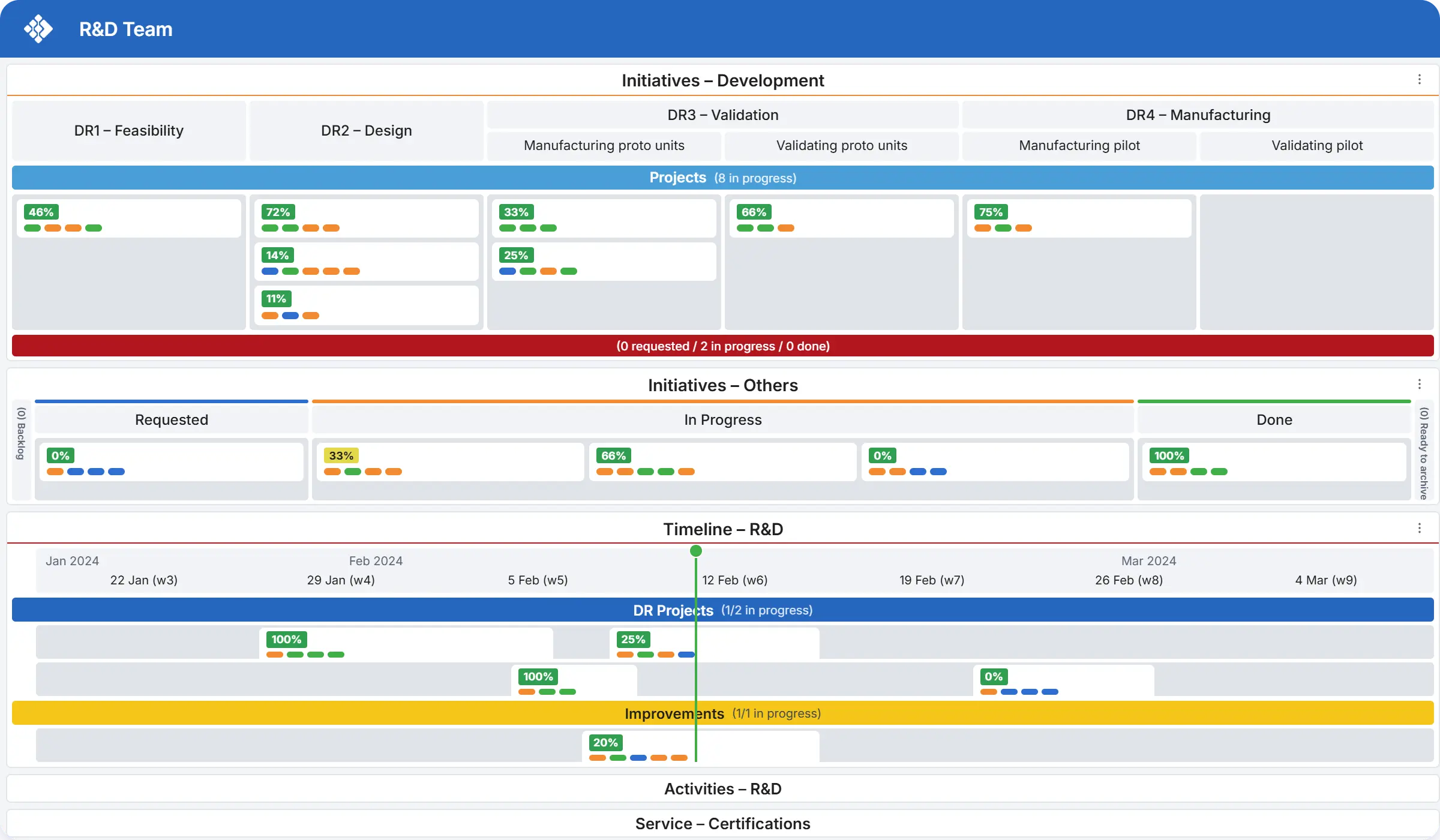 Engineering work management board in Businessmap
ISO 9001 policies built into the workflow
Many companies document a quality process that differs from how work actually happens. The division solved this by placing each step’s ISO 9001 policies directly on its Businessmap workflow, so the "definition of done" is visible where the work happens. At the latest audit, external auditors noted that the company truly "lives and breathes" its processes.
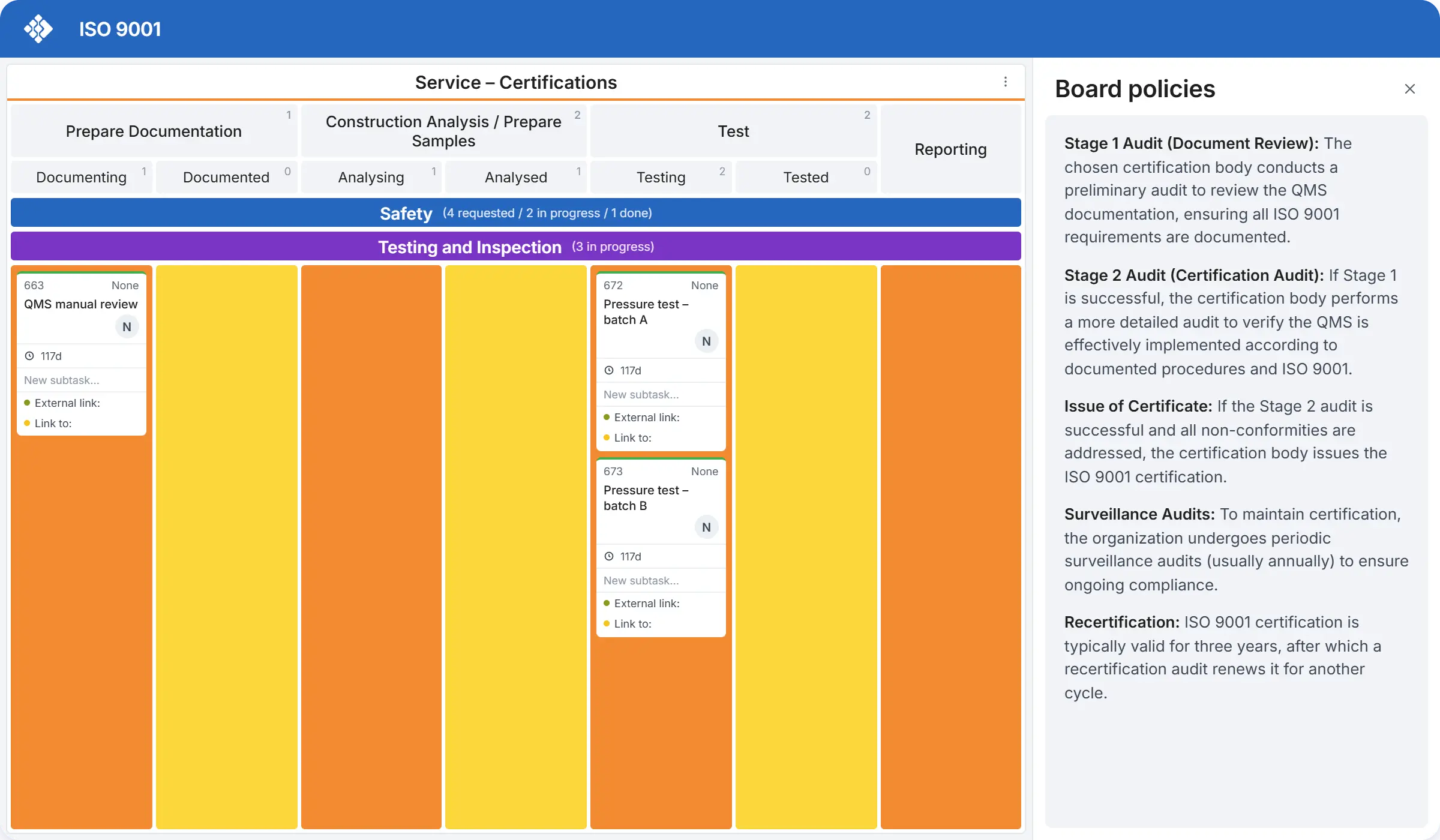 Integrating QMS policies into engineering workflow
Connecting strategy to execution with Flight Levels
The division is now adopting Klaus Leopold’s Flight Levels model, with three connected board levels in Businessmap:
- Strategic projects (Level 3): leadership visualizes ideas and long-term initiatives.
- Value streams (Level 2): linked workflows coordinate work across teams and services.
- Team work (Level 1): teams plan and run their daily work.
Monthly flow reviews and strategy reviews every 6–12 months keep the levels aligned.
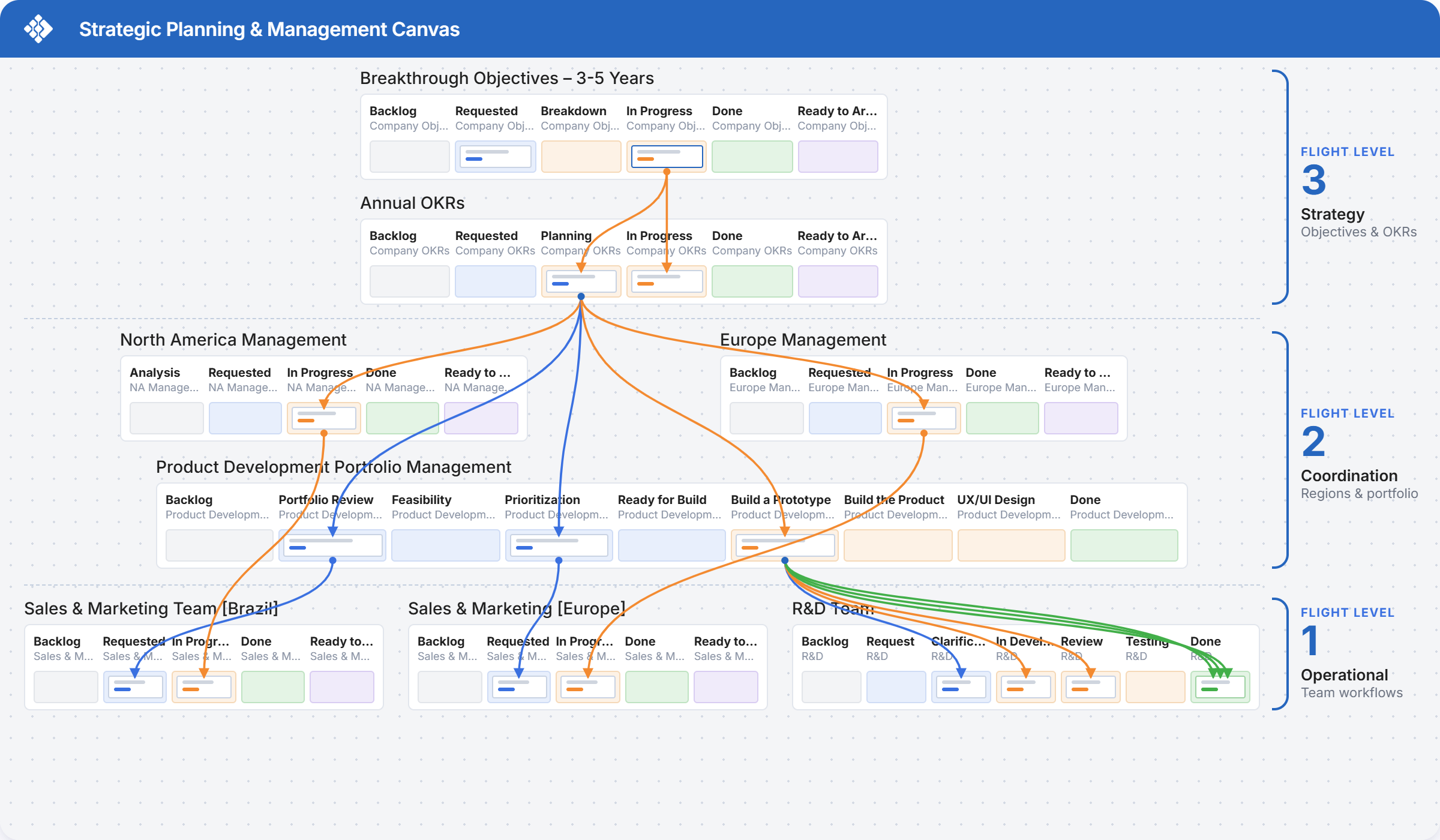 Visualizing Flight Levels on a Businessmap whiteboard
The impact: Faster products and a growing division
Since the transformation began, the division has achieved:
- Development time down from 36 to 26 months, a reduction of nearly 30%, with a target of 18 months.
- 250% growth in divisional turnover.
- ISO 9001 audits passed, with auditors confirming the processes are followed in practice.
- Strategy linked to execution through connected board levels.
- Continuous improvement built into every stage. For example, a lessons-learned review with all teams is an exit requirement at DR4 (Manufacturing).
The company is now extending the Kanban method to more European divisions. As the General Manager puts it: "Happy employees make great products, great products make happy customers, happy customers happily pay invoices."
Implemented with Xuviate
Xuviate is an international project management consultancy and Businessmap Platinum Partner, based in Germany. It helps industrial manufacturers move from spreadsheets to visual, real-time project and process management, working hands-on alongside their teams. xuviate.com



