Enterprise project management (EPM) is essential for organizations looking to scale and align projects with strategic business goals. Without a centralized approach to managing multiple projects and portfolios, companies often face inefficiency, lack of transparency, and missed opportunities. In this guide, we explore how EPM solves these challenges and why it's crucial for large organizations.
What Is Enterprise Project Management (EPM)?
Enterprise project management (EPM) is the practice of managing multiple projects, programs, and portfolios across an organization in a coordinated, strategic way that supports business objectives. It provides a 360-degree view of the organization's collective efforts, ensuring that projects not only deliver on time and within budget but also contribute to the organization's strategic vision and long-term success.
At its core, EPM enables leaders to answer questions such as:
- Are we investing in the right work?
- Do we have capacity to deliver what we promised?
- Are initiatives aligned with strategy?
By adopting EPM, large organizations can enhance portfolio visibility, improve decision-making, and drive better outcomes. It's not just about managing individual projects but ensuring resources and teams are aligned with business priorities.
What Is an Enterprise Project Management Office (EPMO) and What Does It Do?
The Enterprise Project Management Office (EPMO) is the governance body that oversees all project, program, and portfolio activities within an organization. Its primary function is overseeing all enterprise-wide project, program, and portfolio management activities.
Key Roles of the EPMO
- Align all initiatives with organizational strategy and priorities.
- Standardize project processes and governance across departments.
- Provide real-time visibility into project and portfolio performance.
- Facilitate prioritization and decision-making for investments and resources.
- Implement enterprise risk and performance metrics.
Unlike a traditional project management office (PMO) that typically focuses on operational delivery within a single department, the EPMO serves as a strategic partner to the executive team. It supports cross-functional alignment, which is crucial for ensuring that all teams are working towards the same organizational goals.
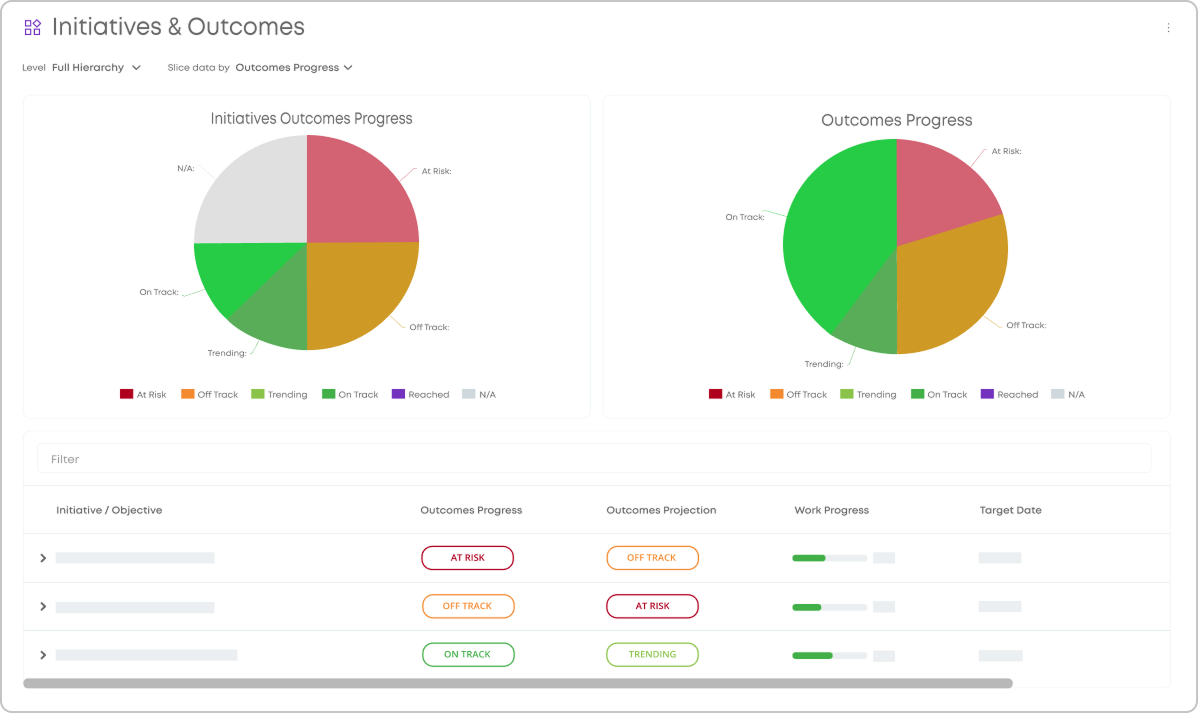 A real-time dashboard view of goals and KPIs progress in Businessmap
Key Principles & Best Practices of Enterprise Project Management
Successful EPM is built on several foundational principles:
Strategic Governance
Ensure that every initiative is governed with consistent standards and aligned to organizational goals. Projects should be reviewed regularly to ensure they continue to meet evolving business goals.
Standardized Processes
Use uniform project delivery frameworks and reporting standards across all teams. This includes adopting uniform tools, reporting, and methodologies.
Centralized Visibility
Maintain a unified view of all projects and portfolios to inform decisions and resource plans. Centralized dashboards allow leaders to track performance and resource utilization in real-time.
Resource & Capacity Planning
Plan and allocate resources across portfolios to prevent overload and maximize utilization.
Continuous Strategic Alignment
Regularly review portfolios to ensure that resource spend and project outcomes support evolving business strategy.
How Is Enterprise Project Management Different from Regular Project Management?
EPM differs from regular project management in the following ways:
| Enterprise Project Management (EPM) | Regular Project Management |
|---|---|
| Manages multiple projects across departments | Focuses on individual projects |
| Strategic alignment with organizational goals | Tactics to deliver one project successfully |
| Enterprise-wide resource planning and governance | Team-level scheduling and task delivery |
| Portfolio tracking across time horizons | Single execution lifecycle |
In other words, EPM answers the question "Are we doing the right work?" while project management answers "Are we doing work right?"
What Methodologies Are Used in Enterprise Project Management?
EPM organizations typically use a mix of methodologies, depending on project type:
- Waterfall: A sequential, phase-based approach suited to predictable, well-defined work.
- Agile: An iterative, adaptive model focused on incremental value delivery and feedback loops.
- Hybrid: A blend of Waterfall and Agile to leverage both structure and adaptability for complex portfolios.
These methodologies provide flexibility when managing portfolios with diverse project types, from regulatory programs to digital transformation initiatives.
For large organizations, hybrid is often the preferred approach, as it balances structure with flexibility, allowing teams to adapt while maintaining some predictability and control.
What Are the Main Benefits of Implementing Enterprise Project Management?
Implementing EPM brings numerous advantages to large organizations:
✔ Strategic Alignment
EPM ensures that every initiative supports the business strategy and delivers measurable value.
✔ Increased Visibility
With real-time data, leaders can easily assess the status across projects and portfolios, enabling better decision-making and faster action.
✔ Consistent Processes
EPM enforces standard practices across departments, ensuring consistency and higher-quality outcomes.
✔ Resource Optimization
Enterprises avoid over-allocating people or budget by planning work across all teams and time horizons.
✔ Risk Mitigation
Early detection and management of risks that span multiple teams or business units.
✔ Reporting
Advanced reporting and analytics tools provide detailed insights into project performance, helping to identify bottlenecks and opportunities for improvement.
EPM is key to transforming how large organizations execute initiatives and achieve their goals.
Equinor, a leading energy company, faced challenges with aligning teams and maintaining visibility across departments. Businessmap's PPM capabilities enabled them to create a centralized environment for managing both strategic initiatives and operational work. Integrating OKRs enabled real-time alignment of projects with strategic goals, resulting in improved transparency, better alignment between strategy and execution, and enhanced collaboration across teams. This streamlined approach helped teams to stay focused on their priorities and significantly boosted overall project management efficiency.
Equinor Success Story
Read Case StudyHow Does EPM Support Strategic Alignment & Portfolio Management?
EPM integrates strategic planning with execution by:
- Evaluating and prioritizing initiatives based on strategic impact.
- Linking budgets and resources to high-value projects.
- Tracking outcomes and KPIs across portfolios to ensure alignment with strategic goals.
By using portfolio management as a central discipline within EPM, organizations ensure that work is always tied back to business performance objectives.
With Businessmap, organizations can track real-time project performance, optimize resources, and ensure alignment with corporate goals, making it an ideal solution for managing enterprise portfolios.
Enterprise Project Management vs. Project Portfolio Management (PPM): What's the Difference?
While both EPM and PPM (Project Portfolio Management) aim to improve project outcomes, they differ in scope:
- EPM is the broader framework that encompasses managing all projects across the organization, ensuring they align with business strategy and corporate goals.
- PPM focuses specifically on evaluating, prioritizing, and optimizing a collection of projects to achieve strategic objectives.
In other words, PPM handles which projects should be funded and why, while EPM provides how these projects are managed across the enterprise.
How to Choose the Right Enterprise Project Management Software
When selecting EPM software, focus on strategic fit and how well the tool integrates with your PMO structure and organizational goals, rather than simply focusing on a list of features. The tool should support governance and scalability, not just task management.
Nevertheless, when selecting EPM software, consider:
✔ Strategic Needs Assessment
Understand your organizational goals and pain points before choosing technology.
✔ Scalability
The solution must grow with your organization's project volume and complexity.
✔ Governance & Compliance
Ensure support for audit trails, process standards, and security policies.
✔ Integrations
The tool should integrate with core systems like ERP, CRM, and BI platforms.
✔ Advanced Reporting
Advanced reporting provides leaders with the data needed for strategic decisions.
✔ Resource & Portfolio Views
A unified view of resources and portfolios enables smarter planning and risk avoidance.
EPM tools must ensure cross-functional alignment by providing a single source of truth, where all departments can access real-time updates and track the progress of shared initiatives. This centralized visibility is essential for ensuring consistent collaboration and informed decision-making across the organization.
Compare shortlisted vendors based on these criteria to ensure you choose a solution that supports enterprise governance and execution at scale.
What Are the Key Features of EPM Tools?
EPM solutions offer features that allow executive teams to view real-time project data through executive dashboards, rolling up KPIs, OKRs, risks, revenue, and other critical metrics, providing visibility into the overall health of projects while still enabling teams to manage daily execution efficiently.
An ideal EPM tool should have the following features:
- Resource management to optimize team allocation and avoid overload.
- Portfolio views for a comprehensive overview of multiple projects.
- Advanced reporting to track key performance metrics and support decision-making.
- Strong AI capabilities to support fast work management, problem detection, data analysis, and more.
- Integrations with other systems to unify data across platforms.
- Security & compliance features to meet enterprise standards.
- Single Sign-On (SSO) for ease of access and secure logins.
See how Businessmap's integrated approach simplifies portfolio tracking, resource optimization, and real-time project monitoring.

Iva Krasteva
Content Strategist | Agile Practitioner | Kanban Certified
Iva is a Kanban-certified Agile expert with hands-on experience in SEO, content creation, and Lean practices. She has published dozens of articles on Lean, Agile, and Kanban practical applications. Iva actively promotes collaborative, flexible work environments and regularly shares process optimization insights through writing.