GROB-WERKE, a German machine-tool manufacturer with around 6,000 employees, started using Businessmap in 2012 to fix the meetings of a single construction project. Today, the company runs more than 1,000 Kanban boards holding 1.6 million cards. Its engineering teams receive tasks straight from SAP, and creating a task now takes over 90% less time than before.
What I like most about this story is how unglamorous the starting point was. Nobody launched a company-wide transformation program. One project leader was tired of meetings that ran out of time, and he went looking for a better way to work.
Christian Lisiecki, Head of Battery Systems Business Unit at GROB-WERKE, on how the company uses Businessmap
GROB-WERKE at a Glance
- Industry: Machine-tool manufacturing, Germany
- Company size: About 6,000 employees
- Starting point: One Kanban board for a logistics hall construction project (2012)
- Today: More than 1,000 work boards and 1.6 million cards
- SAP integration: 30+ visual boards syncing around 16,000 records a day in both directions
- Biggest gain: Over 90% less time spent creating engineering tasks
The Challenge: Meetings Ran Out of Time Before Reaching What Mattered
In 2012, Christian Lisiecki was leading the construction of a new logistics hall at GROB-WERKE. He had seen the same pattern on project after project. Teams worked through long open-item lists in recurring meetings, one item at a time, until the clock ran out.
The result was predictable. The most relevant points often went undiscussed, and teams lost focus.
The Solution: Kanban Boards That Show Only What Each Meeting Needs
Christian discovered flow management and the Kanban method, compared four tools, and chose Businessmap.
Meetings were the first thing to change. Instead of reading through a full list, teams now review only the cards relevant to that specific meeting. The important points get covered because they are the only points on the table.
This is Kanban doing what it does best: you start with what you already have, make the work visible, and improve from there. GROB-WERKE didn't need to redesign its organization first. It needed a clearer picture of its work.
The Scale-Up: From One Project to More Than 1,000 Boards
From that first construction project, Businessmap spread across the company. Teams now use it to run recurring improvement projects, each with its own members and tasks on dedicated work boards.
The numbers show how far that one experiment travelled:
- 1,000+ boards across the organization
- 1.6 million cards (work items) managed in Businessmap
- Engineering and continuous improvement work both running on the platform
Adoption at this scale rarely comes from a mandate. It comes from people seeing a neighboring team's board and wanting the same clarity for their own work.
Learn more about Businessmap Kanban boards↗
The SAP Integration: Network Plans Become Personal Task Lists
The biggest efficiency gain came from engineering. GROB-WERKE plans engineering work in SAP network plans, which grow large and hard to follow as projects progress. For an individual engineer, finding "what do I need to work on next?" inside a sprawling network plan is slow and error-prone.
So the company connected SAP to Businessmap through the Businessmap API. Here is how the workflow runs:
- Tasks are defined in SAP network plans, as before.
- Businessmap automatically creates a card for each task on the relevant board.
- Each engineer filters the board to see only their own workload.
- Updates flow back to SAP, so both systems stay current.
More than 30 work boards now sync with SAP, exchanging around 16,000 records a day in both directions. SAP remains the system of record for planning, while Businessmap becomes the place where engineers actually see and move their work.
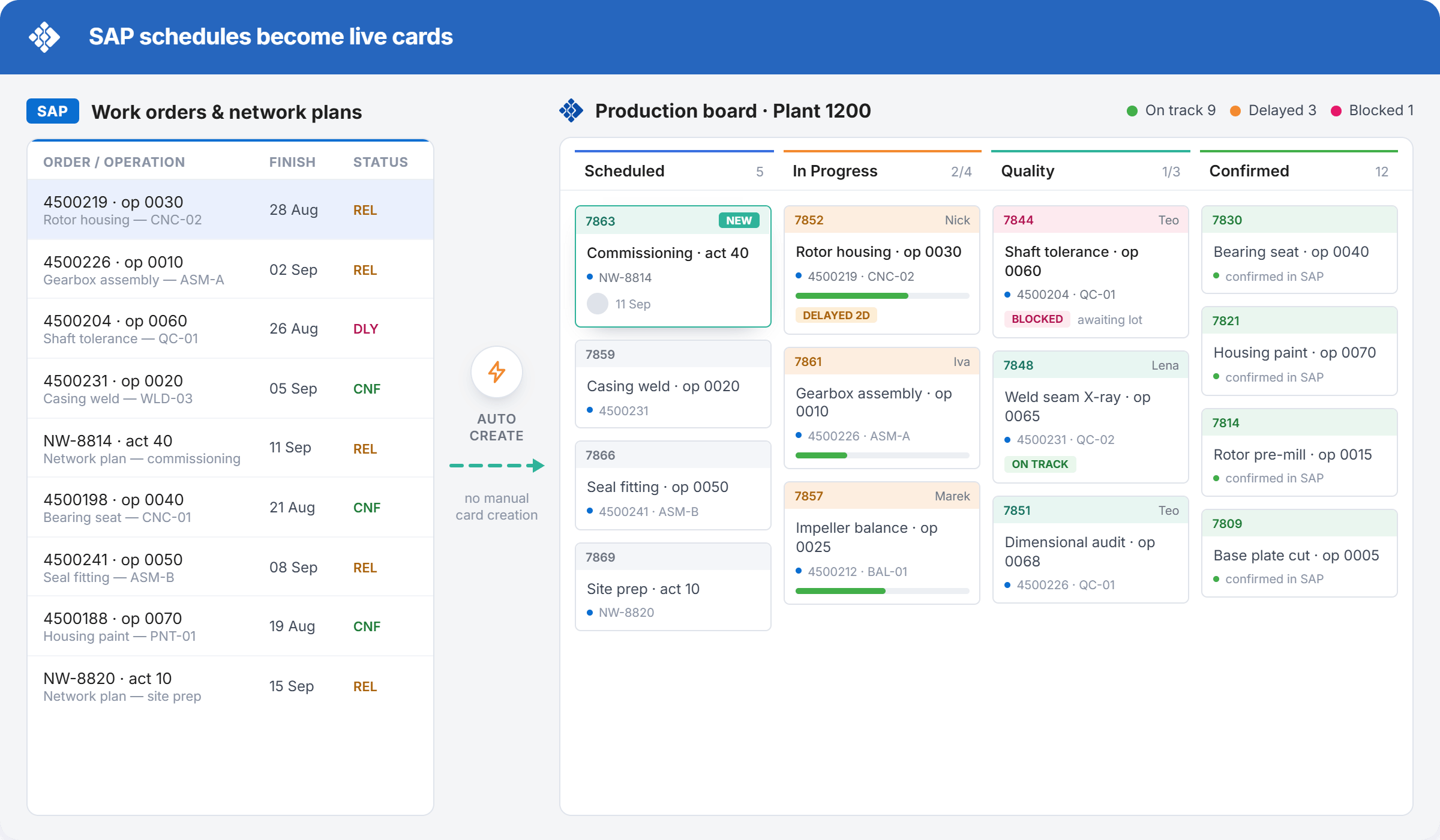 Automatically converting SAP work orders into trackable cards inside Businessmap boards
Learn more about Businessmap integrations↗
Learn more about Businessmap's PPM integration capabilties with SAP↗
The Results: Measurable Time Savings at Every Step
GROB-WERKE measured the impact at three points in the engineering workflow:
Each of these gains is meaningful alone. Stacked across thousands of engineering tasks every day, they add up to a significant amount of capacity returned to the people doing the work.
Engineering teams move faster when they see their work clearly, not when they dig for it in ERP task lists.
Explore Businessmap for Engineering Teams
What Other Engineering Organizations Can Learn From GROB-WERKE
In my view, three lessons stand out for anyone leading transformation or continuous improvement in an engineering-heavy company:
- Start with one visible pain point. GROB-WERKE didn't begin with SAP integration or a portfolio rollout. It began with one project's meetings, and the early win built trust in the approach.
- Keep your system of record, but stop forcing people to work inside it. ERP systems are built for planning and control, not for an engineer's daily view of their work. Connecting the two lets each tool do what it does well.
- Let adoption spread through visible results. A thousand boards didn't appear overnight. They grew because teams could see what worked elsewhere.
Final Thoughts
GROB-WERKE's story is a reminder that lasting change in engineering organizations often starts small. A fix for one project's meetings became the way engineering and improvement work runs across a 6,000-person manufacturer.
If your teams are buried in ERP task lists or status meetings that never reach the real issues, the same path is open to you: make the work visible, connect it to the systems you already rely on, and let the results do the convincing.
Read more Businessmap customer case studies↗
FAQ
How does GROB-WERKE connect SAP to Businessmap?
GROB-WERKE uses the Businessmap API to sync tasks from SAP network plans into Businessmap boards. Cards are created automatically, and updates made in Businessmap flow back to SAP.
How much time did GROB-WERKE save with the SAP integration?
Creating a task takes over 90% less time, confirming a task in Businessmap instead of SAP saves over 30%, and working on a board instead of a list is about 20% faster.
How many boards does GROB-WERKE use?
More than 1,000 boards holding 1.6 million cards, with over 30 of them syncing around 16,000 records a day with SAP.

Michaela Toneva
Kanban & Agile Practitioner | SEO & Content Creator
With a never-ending thirst for knowledge and a passion for continuous improvement, Michaela is an Agile practitioner with a good understanding of Kanban, Lean, and Agile methodologies. Her professional background includes SEO and content writing with a dose of sales and a pinch of social media.