Basecamp has long been known for its simplicity. But as organizations grow, many teams begin searching for alternatives that offer deeper visibility, automation, and scalability.
According to data from Capterra, 78% of Basecamp reviewers are from small businesses, with marketing and administrative teams representing a large share of users. While this makes Basecamp popular for lightweight collaboration, organizations managing complex initiatives often need tools built for structured workflows and multi-project coordination.
In our experience working with enterprise transformation teams, the search for a Basecamp alternative usually begins when leaders start asking questions like:
- How to coordinate multiple projects & portfolios across teams?
- Which initiatives connect to strategic goals?
- How do we automate repetitive work across teams?
This guide explores the best Basecamp alternatives in 2026 and helps you determine which platform fits your organization's needs.
What are the best basecamp alternatives?
The best Basecamp alternatives include Businessmap, Asana, ClickUp, Monday.com, Wrike, Smartsheet, Teamwork, and Trello. These tools offer advanced capabilities such as workflow automation, Gantt charts, portfolio visibility, and integrations. Organizations typically choose these alternatives when they need more advanced project planning, reporting, or scalability than Basecamp provides.
Why Are Teams Looking for Basecamp Alternatives
Basecamp excels at communication and lightweight task management. However, organizations running multiple projects often encounter limitations.
Most Basecamp users appreciate its ability to centralize discussions and reduce email overload, but some reviewers report that notifications can be excessive and difficult to customize.
As teams scale, several limitations become more visible.
Limited Project Visualization
Basecamp does not offer native Gantt charts or advanced workflow visualization, making timeline planning difficult.
Minimal Automation
Teams must manually manage recurring tasks and processes.
Weak Reporting
Leadership lacks the portfolio-level insights needed for strategic decision-making.
Limited Enterprise Features
Large organizations need permission controls, advanced integrations, and scalable workflows.
When teams reach this stage, they usually require a work management platform rather than a simple collaboration tool.
Basecamp Alternatives Comparison Overview
While many Basecamp alternatives offer task tracking and collaboration, platforms designed for workflow visualization and multi-project coordination tend to perform better for complex environments.
8 Best Basecamp Alternatives for Modern Teams
Below are the strongest Basecamp alternatives, ranked by workflow control, automation, scalability, and integrations.
1. Businessmap - Best for Project Portfolio Management and Strategic Alignment
For organizations that have outgrown Basecamp's lightweight task management, Businessmap offers a powerful system for coordinating complex work across teams and portfolios.
Unlike Basecamp, which focuses mainly on communication and simple task tracking, Businessmap helps organizations connect strategic initiatives with operational execution.
Businessmap is the first platform we've used that genuinely connects strategy, execution, and value delivery in a practical and scalable way. — Gartner Peer Insights review
Capterra data shows that:
- 44% of Businessmap reviewers come from enterprise organizations
- 78% of users report using the platform daily
- IT and software development teams represent the largest user group.
Enterprise teams often adopt Businessmap because it enables:
- Portfolio-level visibility across multiple teams
- Hybrid work management - Kanban, Scrum, Gantt charts, etc.
- Native work analytics, reports, and AI insights into performance data
- Automation rules that enforce workflow policies
- Traceability
Businessmap connects corporate strategy, project portfolios, and daily task execution in a single system, allowing leadership to monitor progress and identify bottlenecks early.
This makes it especially valuable for organizations undergoing digital transformation or scaling Agile practices across departments.
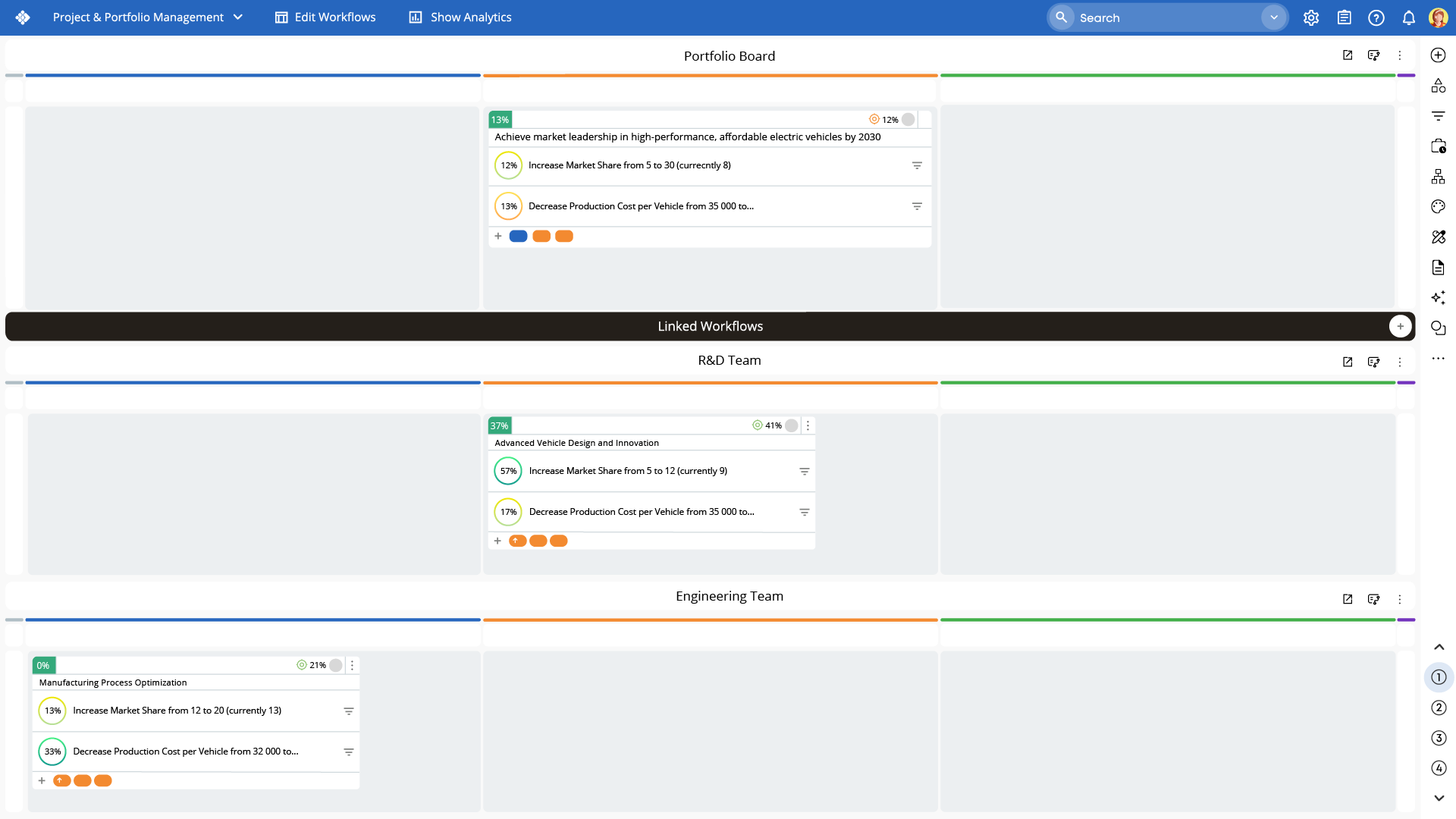 A portfolio management board linking portfolio goals to R&D and Engineering workflows
2. Asana - Best for Creative Work Management
Asana is a popular Basecamp alternative for teams that want clear task ownership and structured workflows. Users highlight project progress tracking as one of Asana's strongest capabilities, helping teams visualize status and collaborate more effectively.
Key features include:
- Timeline views
- Task dependencies
- Workflow automation
- Reporting dashboards
Asana works particularly well for cross-functional teams managing multiple projects simultaneously.
However, larger enterprises may find portfolio capabilities somewhat limited compared to enterprise work management platforms.
3. ClickUp - Best for Task Management & Customization
ClickUp positions itself as an "all-in-one productivity platform."
Strengths include:
- Highly customizable workflows
- Built-in documents and knowledge bases
- Automation engine
- Time tracking
Teams that enjoy tailoring their tools often gravitate toward ClickUp. Many reviewers also appreciate its comprehensive collaboration features, though some report limited mobile functionality, and new users may face a steeper learning curve.
4. Monday.com - Best for Daily Work Management with AI
Monday.com enables teams to plan, track, execute, and automate workflows across projects, tasks, and processes in a visual, collaborative environment.
Notable capabilities:
- Custom dashboards
- Automation rules
- Visual workload management
- Integrations with major tools
It works particularly well for marketing, operations, and product teams.
Users appreciate real-time visibility into projects but often mention pricing complexity as a challenge.
5. Wrike - Best for Enterprise Collaboration
Wrike is designed for organizations with complex collaboration needs.
Core strengths:
- Enterprise security
- Custom workflows
- Advanced reporting
- Resource planning
Wrike's standout feature is its strong project tracking capabilities, but users frequently cite high pricing and add-on costs as challenges.
6. Smartsheet - Best for Spreadsheet-Based Planning
Smartsheet blends project management with spreadsheet-style workflows.
Features include:
- Project scheduling
- Workflow automation
- Reporting dashboards
- Resource management
Teams already comfortable with Excel often find Smartsheet easy to adopt. While collaboration is widely praised, licensing limitations and higher costs for premium capabilities are among the software's drawbacks.
7. Teamwork - Best for Client-Based Projects
Teamwork is popular among agencies and consulting firms.
Key capabilities:
- Client collaboration tools
- Time tracking
- Billing and invoicing
- Project templates
This makes it a strong Basecamp alternative for professional services teams.
Users appreciate Teamwork's project organization features, though some report complex navigation and hidden functionality.
8. Trello - Best for Simple Kanban Workflows
Trello offers a lightweight project management approach using Kanban boards.
Features include:
- Drag-and-drop workflows
- Automation via Butler
- Power-ups for integrations
While Trello is flexible, it may not be sufficient for large-scale project management.
How to Choose the Right Basecamp Alternative
Selecting the right tool depends on organizational maturity and complexity.
Consider the following questions:
How complex are your projects?
- For basic collaboration - Trello
- For creative & client-facing work - Asana, Teamwork
- For enterprise project and portfolio management - Businessmap
Do you need workflow automation?
Automation-heavy teams should evaluate:
- Businessmap
- ClickUp
- Monday.com
Do you need strategic portfolio visibility?
Enterprise leaders typically choose platforms that support:
- portfolio management
- cross-team coordination
- advanced analytics
Basecamp vs. Businessmap: Which Tool Fits Growing Organizations?
Teams evaluating Basecamp alternatives often compare it directly with Businessmap. While both platforms help teams coordinate work, they are designed for very different levels of complexity.
| CAPABILITY | Basecamp | Businessmap |
|---|---|---|
| Primary focus | Team communication and simple task coordination | End-to-end work management and strategy execution |
| Workflow visualization | Basic task lists and message boards | Advanced Kanban boards with customizable workflows |
| Portfolio visibility | Limited | Full portfolio and initiative tracking |
| Automation | Minimal | Advanced workflow automation rules |
| Analytics | Basic reporting | Data performance analytics, forecasting, and AI delivery insights |
| Capacity/Resource Planning | No granular resource management | Premium service available for enterprise-level planning and |
| AI capabilities | No built-in AI capabilities | Out-of-the-box AI features for predictive insights, text generation & more. Native MCP server integration with external AI tools. |
In practice, Basecamp works well for small teams coordinating projects, while Businessmap is better suited for organizations managing complex initiatives across multiple teams and departments.
FAQs
What is the best Basecamp alternative?
The best Basecamp alternative depends on your needs. Teams requiring advanced workflow management often choose Businessmap, while smaller teams may prefer Asana or Monday.com.
Do any Basecamp alternatives offer Gantt charts?
Yes. Tools such as Businessmap, Asana, ClickUp, Monday.com, and Smartsheet include built-in Gantt view functionality for project timeline management.
Which Basecamp alternative has the best automation?
ClickUp, Monday.com, and Businessmap offer powerful automation features that allow teams to automate workflows, notifications, and task transitions.
What is the most scalable alternative to Basecamp for enterprises?
Platforms like Businessmap, Wrike, and Smartsheet provide enterprise-grade capabilities. Businessmap is the only platform that seamlessly includes resource, capacity, and portfolio management capabilities with strategic alignment and AI.
Explore how Businessmap can transform your work management system.

Michaela Toneva
Kanban & Agile Practitioner | SEO & Content Creator
With a never-ending thirst for knowledge and a passion for continuous improvement, Michaela is an Agile practitioner with a good understanding of Kanban, Lean, and Agile methodologies. Her professional background includes SEO and content writing with a dose of sales and a pinch of social media.