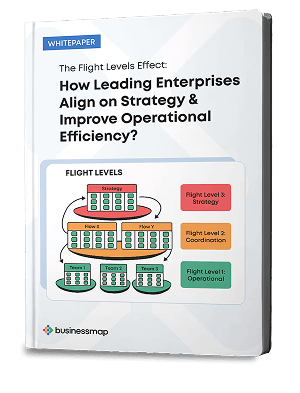
The best Planview alternatives in 2026 include Businessmap, Clarity (Broadcom), Jira Align, and other enterprise portfolio management platforms. Businessmap's PPM solution stands out for connecting strategy, portfolios, and execution in one unified system, making it the strongest alternative for large organizations seeking real-time strategic alignment and enterprise visibility.
Key Takeaways
Modern enterprises need real-time visibility from OKRs to team-level work. Traditional PPM tools excel in financial governance, but often require longer deployments and higher total cost of ownership.
Businessmap stands out as the most balanced Planview alternative, combining portfolio governance, flow analytics, and AI-driven insights in one unified system.
The right alternative depends on your operating model - SAFe-driven enterprises may prefer Jira Align, while transformation-focused organizations benefit from flexible, Lean portfolio platforms.
Why Enterprises Are Actively Searching for Planview Alternatives
Planview has long been a recognized name in enterprise portfolio management. For many IT PMOs, it became the default system for financial governance, demand intake, and structured portfolio reporting.
But enterprise portfolio management has changed.
Today, the real challenge is not tracking projects. It's aligning business strategy with IT portfolios and work execution across multiple teams, departments, and value streams in real time.
As organizations grow more cross-functional and transformation-driven, many leaders begin asking:
- Why is strategic planning disconnected from delivery?
- Why does portfolio reporting require heavy configuration or manual consolidation?
- Why does executive visibility lag behind operational reality?
- Why does it take months to implement changes in our portfolio system?
- Why is there misalignment between strategy and work execution across multiple teams?
This is where the search for Planview alternatives begins.
What to Look for in a Planview Alternative?
Choosing a Planview alternative is not about replacing features. It's about upgrading your operating model.
True Strategy-to-Execution Alignment
Many portfolio systems manage projects. Fewer connect them meaningfully to strategy.
A modern enterprise platform must:
- Map strategic objectives (OKRs, KPIs, themes) to initiatives
- Connect initiatives to programs and delivery-level work
- Provide bidirectional visibility from boardroom to team level
- Show progress against strategic goals in real time
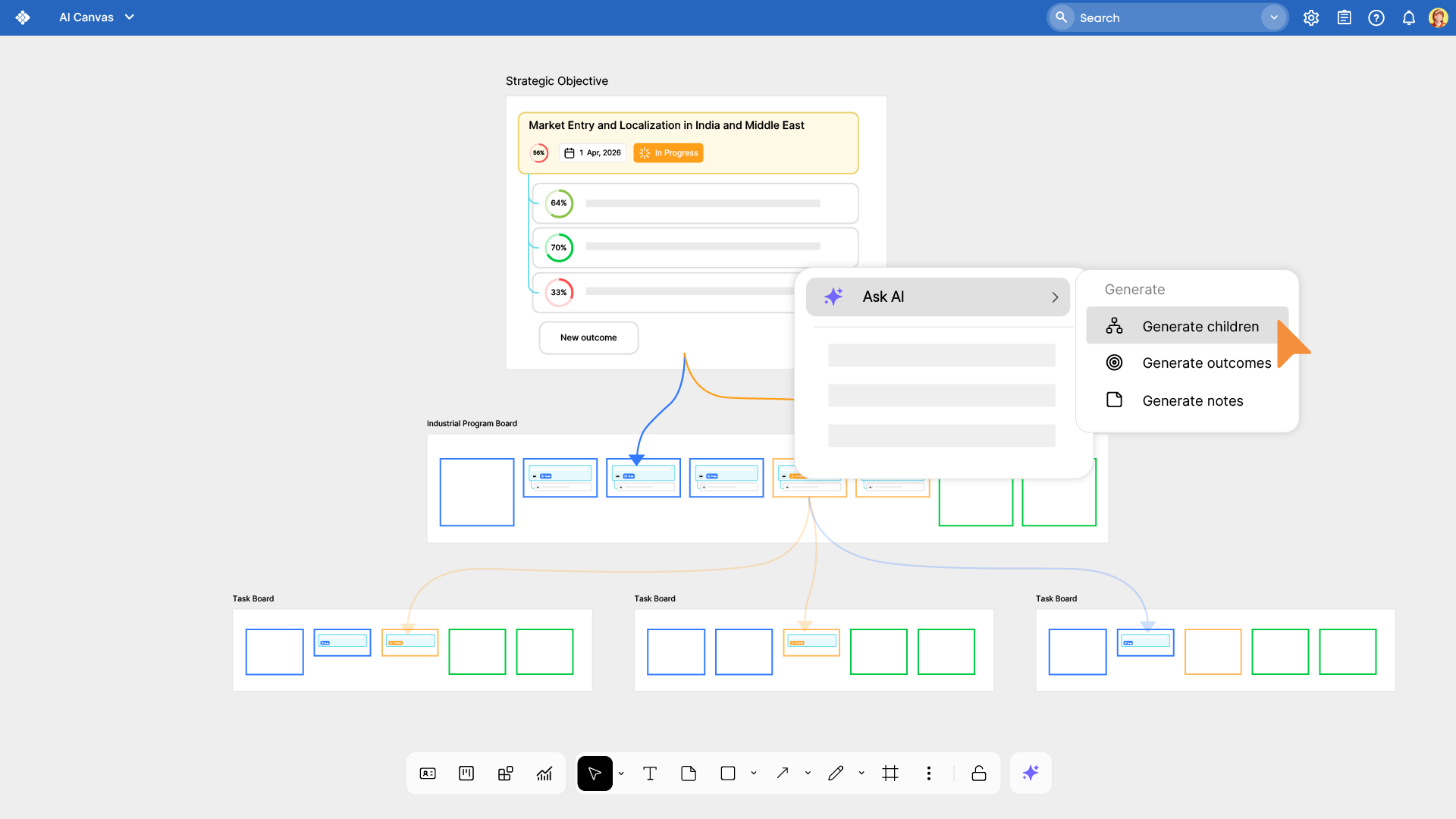 Mapping strategic goals, portfolio breakdown, risks, and dependencies on a Businessmap Canvas board
Portfolio Planning Beyond Static Roadmaps
Traditional portfolio tools often rely on structured intake processes and annual planning cycles. But enterprise environments are dynamic. Capabilities like scenario planning and what-if analysis, capacity forecasting across portfolios, and cross-team dependency visualization become crucial.
Executive Dashboards and Reporting that Drive Decisions
One of the most common friction points with legacy enterprise portfolio tools is reporting rigidity. If dashboards require specialized configuration or external layers to provide clarity, decision-making slows down.
A true enterprise-grade alternative should make portfolio visibility intuitive, visual, and immediately actionable.
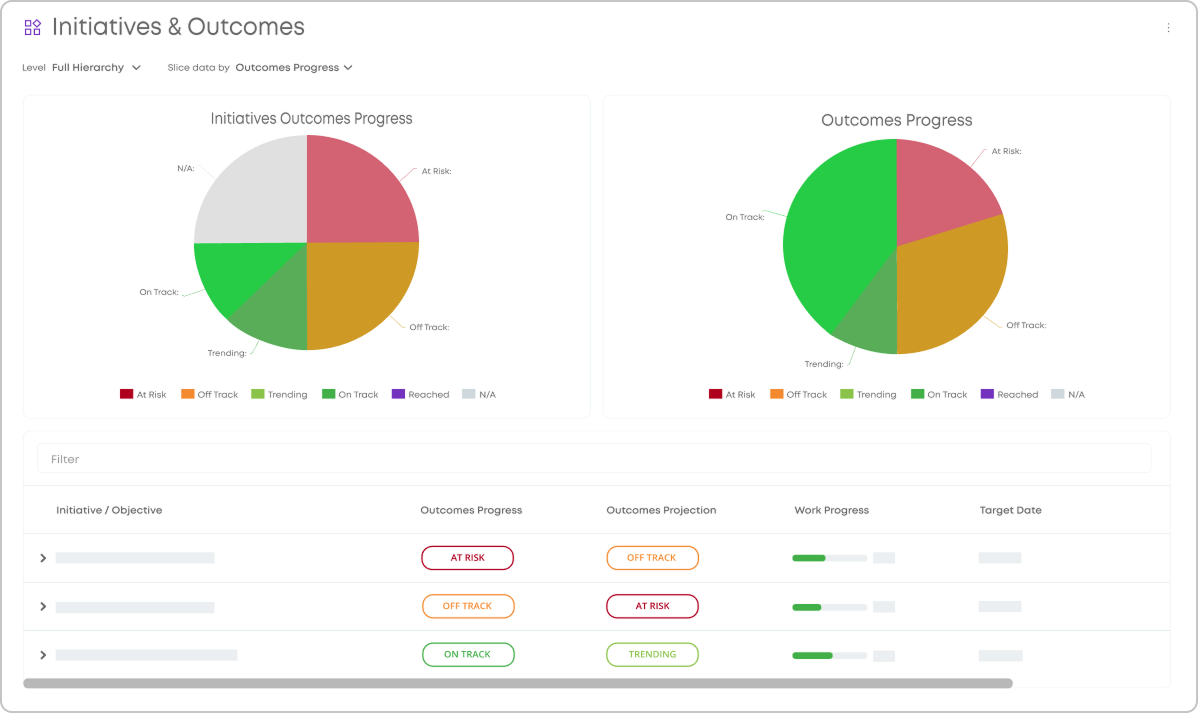 An executive real-time view into goals and KPIs status in Businessmap
Scalability for Large and Complex Organizations
Large enterprises operate across multiple portfolios, global teams, hybrid Agile and traditional environments. The best Planview alternative for large organizations is one that enables complexity without multiplying tools.
Faster Implementation and Lower Total Cost of Ownership
Enterprise portfolio tools are often associated with long deployment cycles and heavy reliance on consulting. Switching to a Planview alternative should offer:
- Faster configuration and rollout
- Native integrations (without multiple plugins)
- Lower customization overhead
- Clear time-to-value within months
Best 6 Planview Alternatives Comparison
| Key Features | Best For | Rating in PPM Category | |
|---|---|---|---|
| Businessmap | Native strategy-to-execution alignment, multi- project coordination, configurable workflows, built-in AI & flow analytics | Enterprises aligning strategy, portfolios, and execution in real time | Gartner: 4.8 |
| Jira Align | SAFe support, strategy room, portfolio funding tools, dependency management | SAFe-driven enterprises using Jira Software | Gartner: 4.4 (Enterprise Agile Planning Tools category) |
| Clarity | Strategic portfolio management, financial planning, resource governance, PSA | Financially governed enterprise PMOs | Gartner: 4.4 |
| Smartsheet | Portfolio dashboards, automation templates, resource tracking, collaboration tools | Cross-functional teams in need of flexible planning | Gartner: 4.4 |
| Planisware Enterprise | SPM, financial,resource, and risk management, AI-enabled workflow automation, instant insights | Org needing advanced financial management |
Gartner: 4.4 |
| Celoxis | Advanced scheduling, risk tracking, custom dashboards, Dev tool integrations | PMOs focused on scheduling precision & reporting | Gartner: 4.4 |
1. Businessmap
Best for large enterprises seeking real-time alignment between strategy and execution across portfolios and value streams.
Businessmap is an enterprise project & portfolio management platform that connects strategy, portfolios, and execution in one unified, visual system. While Planview Portfolios focuses on optimizing programs and resources to accelerate strategic execution, Businessmap delivers that alignment through real-time flow visibility, configurable portfolio structures, and deeply adaptable Kanban-based execution.
Organizations that switch from Planview consistently cite lower cost, greater configurability, better workflow control, and superior customer support.
Where Planview emphasizes governance and integrated business-technology planning, Businessmap operationalizes strategy, making execution visible and measurable at every level of the enterprise.
Key Features
- Native Strategy-to-Execution Alignment: Leaders can map strategic objectives and OKRs, portfolio initiatives and programs, and team-level work items into a single system. Businessmap boards make it easy to trace progress from enterprise goals down to individual work items in real time.
A nonprofit user described Businessmap as: "Perfect Kanban tool to manage and measure value streams and teamwork and to connect them with strategic goals." — Capterra user
- Enterprise Portfolio & Initiative Management: Businessmap offers multi-project coordination, visualization of initiative hierarchies, and cross-team dependencies, enabling the management of complexity without the overhead.
- Configurable Workflow Design: Businessmap provides transparent workflow policies, automation rules, and board customization that reflect real operational processes.
A Head of Operations noted that Businessmap is: "Easily the best digital Kanban tool on the market… infinitely configurable to meet any flow." — Capterra user
- Built-In and AI-Powered Metrics (Without Add-Ons): Built-in analytics, dashboards, and AI insights on performance or any other data without any plugins or additional layers, supporting Lean and Agile enterprises focused on delivery predictability.
- Superior Customer Experience & Support: For enterprise systems where implementation complexity can impact adoption, the level of support significantly reduces risk.
One Business Analytics Manager described the support as: "Superior customer experience to any other support business I've experienced in 15 years." — Capterra user
Pricing: Businessmap offers transparent, scalable pricing with fewer required add-ons. Approx. $7/user/month (1,000+ users). Includes portfolio and analytics without plugins. Add-ons available for workflow automation and SSO. The tiered subscription plans are based on features and the number of users, with enterprise pricing available upon request. Organizations can request a free trial before committing to a full rollout.
Pros & Cons
Users consistently highlight Businessmap's configurability, praising its ability to adapt to virtually any workflow, as well as its exceptional customer support. However, because of its depth and flexibility, organizations may need an initial configuration phase to fully tailor portfolio structures and automation rules for complex enterprise environments.
2. Jira Align
Best for enterprises scaling SAFe or operating in deeply Jira-centric Agile environments.
Jira Align (by Atlassian) unifies strategic objectives with Agile execution for enterprises already using Jira Software. Its Strategy Room ties goals to program backlogs, while portfolio funding tools help track investment priorities. It helps large organizations scale agile practices and align strategic goals, roadmaps, and dependencies across teams, products, and portfolios.
Key Features
- Enterprise Agile Planning: Connects strategic goals with execution and delivery across all organizational layers.
- Portfolio & Program Visibility: Real-time roadmaps and status roll-ups across portfolios.
- Dependency & Risk Management: Visibility into cross-team dependencies and execution risks.
- Framework Support: Built to support SAFe and other large-scale frameworks.
Pricing: Jira Align typically requires a custom enterprise quote and is only available via the Strategy Collection suite at $77,400 annually for 50 seats, and Jira Cloud Premium is a minimum requirement.
Pros & Cons
Jira Align is valued for enterprise agile visibility and strong SAFe support, but organizations often report complexity and a steep learning curve. Businessmap offers comparable strategic alignment and dependency transparency in a more intuitive, flow-based system that doesn't require heavyweight agile frameworks to operate effectively.
3. Clarity (by Broadcom)
Best for governance-driven PMOs prioritizing financial planning and structured investment control.
Clarity is an enterprise strategic portfolio management (SPM) solution that unifies strategy, funding, and execution with real-time financial and resource transparency. It is used to optimize investments, align initiatives to strategic goals, and govern portfolios from strategy to work execution.
Key Features
- Strategic Portfolio Management (SPM): Aligns investments with business strategy and priority.
- Financial & Resource Planning: Integrated budgeting, forecasting, and capacity allocation.
- Unified Dashboard & Reporting: Real-time visibility across all investment types.
- Professional Services Automation (PSA): Tailored tools for delivery teams, including revenue recognition and talent management.
Pricing: Clarity pricing is customized per enterprise needs and typically requires a sales consultation; pricing varies by modules and scale.
Pros & Cons
Clarity is known for robust financial governance and structured portfolio oversight, yet users frequently cite complexity and usability challenges. With custom-built solutions, Businessmap balances financial visibility with visual portfolio flow management, delivering strategic alignment without the administrative overhead.
4. Smartsheet
Best for cross-functional teams and flexible project tracking.
Smartsheet is a collaborative work and project portfolio management platform that combines spreadsheet familiarity with enterprise work orchestration. It centralizes project planning, workflow automation, dashboards, and portfolio reporting, making it suitable for cross-functional teams and enterprise PMOs.
Key Features
- Portfolio Dashboards & Reporting: Real-time visibility into project statuses and risks.
- Resource & Capacity Management: Tools for workload forecasting and balancing.
- Automations & Templates: Prebuilt templates and automated workflows for repeatable processes.
- Collaborative Work Execution: Cross-team collaboration with dynamic forms and update requests.
Pricing: Pro $9/user/month (for up to 10 users), Business $19/user/month (3+ users with unlimited guests and viewers), Enterprise (10+ users) and Advanced Work Management have custom pricing for large organizations. Multiple add-ons available (Resource Management, Control Center, Calendar App). Offers a 30-day free trial.
Pros & Cons
Smartsheet is praised for flexibility and customizable dashboards, though scaling into deeper portfolio governance can become costly or layered. Businessmap combines configurability with built-in Lean portfolio structures, enabling enterprise-level alignment without relying on workarounds.
5. Planisware Enterprise
Best for organizations that need advanced financial management and strategic portfolio planning.
Planisware Enterprise is a traditional PPM suite designed for complex, large-scale enterprises. It excels in deep financial modeling, detailed scheduling, resource optimization, and strategic planning. Planisware supports scenario analysis and portfolio visualization, but it comes with a longer implementation time and a higher total cost of ownership compared to more agile alternatives.
Key Features
- Strategic Portfolio Management: Aligns investments with business strategy and priority, supporting detailed financial forecasting and resource capacity planning.
- Financial & Resource Management: Integrated budgeting, cost tracking, and scenario optimization.
- Scenario & Risk Management: Provides financial modeling, forecasting, risk identification, and dependency management.
- Customizable Dashboards & Reporting: Offers configurable analytics, real-time reporting, and dashboards for executives and PMOs.
Pricing: Customized enterprise pricing model, with additional cost for customization and dedicated admins.
Pros & Cons
Planisware's comprehensive, customizable planning and resource tools support strategic decision‑making and complex portfolio visibility. However, implementation complexity can slow adoption, and higher pricing can present a barrier for teams without dedicated PPM expertise or for smaller organizations.
6. Celoxis
Best for PMOs requiring advanced scheduling, resource tracking, and customizable reporting.
Celoxis is an enterprise project portfolio management (PPM) platform that provides real-time insights through customizable dashboards, advanced analytics, scheduling, resource management, and powerful reporting. It integrates with development tools and supports both cloud and on-premise deployment options.
Key Features
- Custom Dashboards & Analytics: Fully customizable visuals for executives and PMOs.
- Advanced Scheduling & Gantt Charts: Built-in tools for project timelines and dependencies.
- Risk & Time Tracking: Tools for risk management and tracking work
- Integrations with Dev Tools: Native integration with Jira, Azure DevOps, etc.
Pricing: Celoxis offers flexible cloud ($10–$45/user/month, Core to Business; annual billing, min. 5 users) and custom on-premise pricing, with a 14-day free trial. Integrations (Jira, Azure DevOps, QuickBooks Online, Zapier) available via add-ons or the top tier.
Pros & Cons
Celoxis offers strong scheduling and resource-tracking features, but some users report usability challenges. Businessmap pairs advanced analytics with visual flow management, enabling enterprises to manage capacity while maintaining operational clarity.
When Should You Replace Planview?
Replacing Planview is not a technology decision. It's a strategic maturity decision.
Organizations typically begin evaluating Planview alternatives when:
- OKRs, strategic priorities, and portfolio data live in separate systems, making alignment difficult to measure.
- When dashboards require heavy customization, BI layers, or manual consolidation, executive visibility suffers.
- Adding workflows, adjusting governance models, or scaling to new portfolios requires months of configuration; agility is compromised.
- Enterprise licensing and consulting dependencies often increase total cost of ownership over time.
If your organization is shifting toward adaptive planning, value stream visibility, and real-time strategic alignment, it may be time to consider a lightweight PPM solution that operationalizes strategy rather than just reporting on it.
FAQs
What is the best Planview alternative for large organizations?
Businessmap stands out for large enterprises that need real-time strategy-to-execution alignment, multi-project coordination, and Lean portfolio management capabilities in a single system. For teams evaluating cloud options, see our guide to best cloud portfolio management software ↗
How does Businessmap compare to Planview?
While Planview emphasizes financial governance and structured portfolio control, Businessmap connects strategic goals directly to initiatives and execution using visual portfolio boards, configurable workflows, and built-in flow analytics.
What is the best Planview alternative for strategic portfolio planning?
Businessmap and Clarity are strong contenders. Clarity focuses heavily on financial governance, while Businessmap combines strategic planning with operational execution visibility or aligns business strategy with IT portfolios.
Is Jira Align a replacement for Planview?
Jira Align can replace Planview in SAFe-driven enterprises already embedded in Jira. However, it requires mature Agile practices and can be complex to configure at scale.
Are there more cost-effective alternatives to Planview?
Yes. Platforms like Businessmap and Celoxis often offer more flexible pricing models and faster time-to-value than traditional enterprise PPM systems.

Iva Krasteva
Content Strategist | Agile Practitioner | Kanban Certified
Iva is a Kanban-certified Agile expert with hands-on experience in SEO, content creation, and Lean practices. She has published dozens of articles on Lean, Agile, and Kanban practical applications. Iva actively promotes collaborative, flexible work environments and regularly shares process optimization insights through writing.