Enterprise portfolio management has outgrown static reports, scattered spreadsheets, and quarterly meetings where leaders discover problems too late. The best cloud portfolio management software gives organizations a live system for connecting strategy, portfolios, initiatives, and execution so leaders can make better decisions before risks turn into delivery failures.
Key Takeaways
- Cloud portfolio management software helps organizations manage projects, programs, products, and strategic initiatives through a vendor-hosted SaaS platform.
- The best SaaS PPM tools connect strategy, execution, governance, reporting, and decision-making.
- Businessmap is a strong cloud PPM choice for enterprise teams that need enterprise portfolio management, AI-supported insights, workflow visibility, and strategy-to-execution alignment.
- Evaluating cloud PPM pricing: total cost of ownership, time-to-value, implementation effort, integrations, and ROI from better portfolio decisions.
What Is Cloud Portfolio Management Software?
Cloud portfolio management software is a vendor-hosted platform that helps organizations manage portfolios of projects, products, programs, and strategic initiatives through a browser-based system.
Instead of installing software on internal servers, teams access the platform online. This gives executives, PMO leaders, product managers, transformation teams, and delivery teams a shared space to plan, prioritize, track, and improve work across the organization.
A strong cloud PPM platform usually helps with strategic planning, goal alignment, portfolio prioritization, roadmap visibility, project and initiative tracking, risk and dependency management, executive reporting, workflow analytics, capacity insights, and AI-supported decision-making.
Learn more about cloud vs. on-premise PPM software
What Features Should the Best Cloud Portfolio Management Software Include?
The best cloud portfolio management software should help organizations connect strategy, portfolios, and execution in one system.
Check our guide to PPM tool requirements as a useful starting point.
The most important features include:
Strategy-to-execution alignment.
The platform should connect strategic goals, OKRs, portfolio initiatives, projects, and team-level execution. The connection guarantees that leadership sees strategic progress.
Portfolio visibility.
Executives and PMO leaders need real-time views of portfolio health, initiative status, risks, blockers, and delivery progress. Manual status reporting slows decisions and often hides the real problems.
Prioritization and portfolio balancing.
The software should help teams compare work based on value, urgency, risk, dependencies, capacity, and strategic contribution. This prevents the common enterprise pattern of approving too much work and starving the most important initiatives.
How PPM helps in project prioritization
Risk and dependency management.
Portfolio failure often begins with invisible dependencies. A strong cloud PPM platform should make blockers, risks, and cross-team dependencies easy to see and act on.
Custom workflows.
Large organizations rarely work in one way. Some teams use Kanban, others use Scrum, Waterfall, hybrid delivery, product operating models, or service workflows. The best SaaS PPM software should support different ways of working without losing portfolio-level visibility.
Executive dashboards and analytics.
Dashboards should help leaders understand flow, cycle times, delivery trends, blocked work, capacity pressure, and strategic progress.
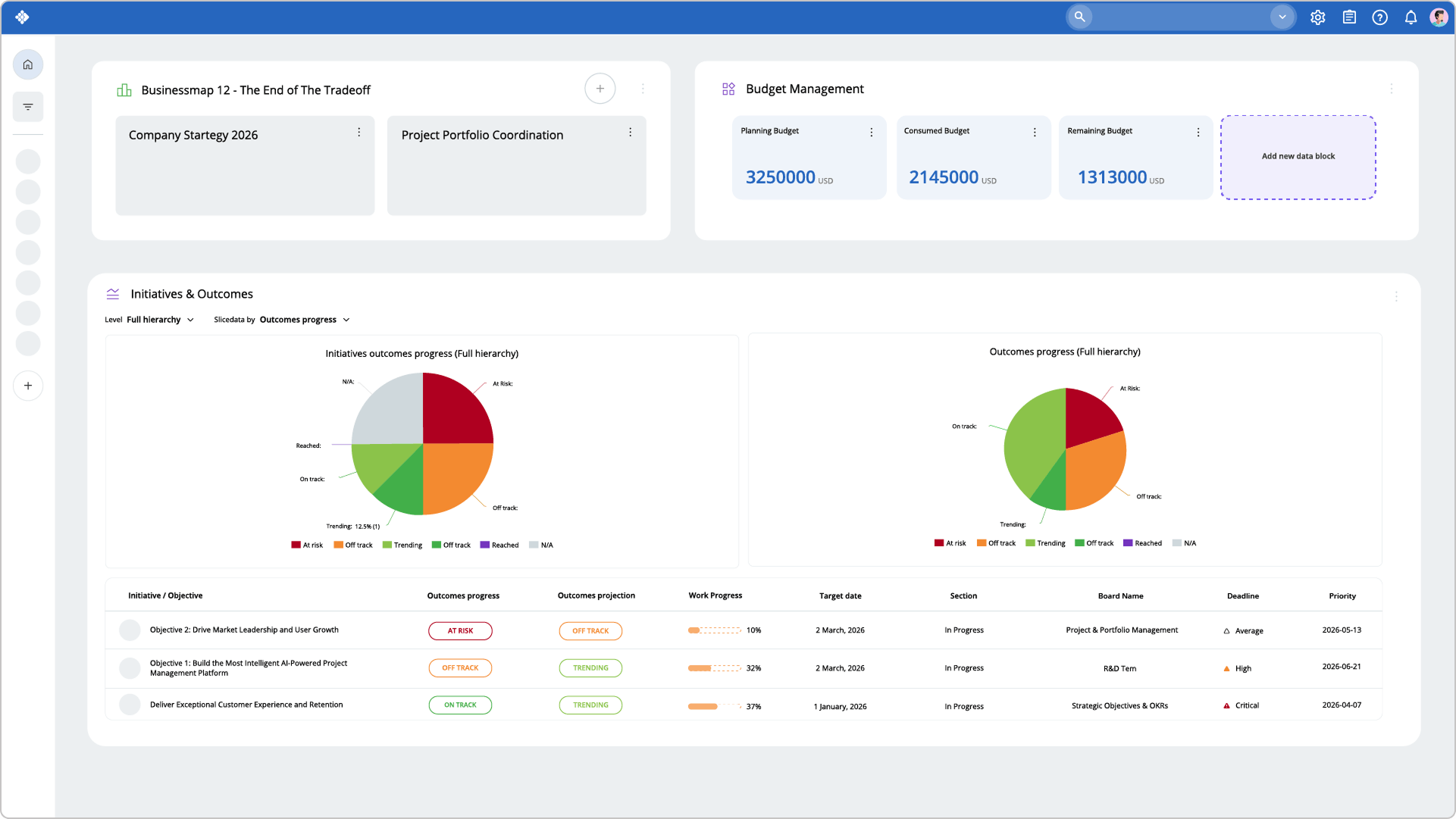 Tracking strategic goals progress and related metrics status using executive dashboards in Businessmap
Learn more about Businessmap's Initiatives & Outcomes Dashboard
Best Cloud Portfolio Management Software: Top Platforms to Compare
The best cloud PPM platform depends on the organization's operating model, governance needs, and implementation maturity. Still, several platforms commonly appear in enterprise evaluations.
Businessmap
Strong fit for: PMOs moving from static reports to live portfolio visibility.
Businessmap is an AI-powered SaaS project and portfolio management platform that helps organizations connect strategic goals with daily execution, improve visibility across teams, and deliver work faster.
For enterprise teams, Businessmap reduces the dependency on disconnected spreadsheets, static reports, and fragmented delivery tools. Leaders can see how strategic initiatives move across portfolios, where work is blocked, which outcomes are at risk, and how execution performance changes over time.
Businessmap may not be the first choice for organizations looking for a traditional, finance-heavy enterprise PPM suite with deep cost accounting as the primary use case.
Key features:
- Visual Portfolio Boards
- Outcomes and OKRs
- Management Dashboards
- AI-Assisted Planning and Insights
- Kanban boards
- Workflow analytics
- Management Dashboards and Reporting
- Automation via business rules
- Integrations and API
- Enterprise Security and Access Management
Meisterplan
Strong fit for: Portfolio-level capacity and planning.
Meisterplan is a project portfolio management software focused on planning resources beyond the short term, resolving resource bottlenecks, monitoring progress, and supporting strategic contribution across initiatives. It is better suited for portfolio-level planning where leadership needs to understand capacity, priorities, timing, and realistic delivery scenarios.
Meisterplan may be less suitable for teams that want one tool for detailed task execution and portfolio governance.
Key features:
- Portfolio-level resource management
- Capacity planning and resource utilization views
- Scenario planning and portfolio simulations
- Project prioritization and strategic alignment
- Resource bottleneck detection
- Portfolio progress monitoring
- Integrations for consolidating planning data
- Enterprise security and role-based planning controls
Planview Portfolios
Strong fit for: Organizations that need to manage complex portfolios, resources, investments, and financials.
Planview is often used by large enterprises with mature portfolio, resource, and financial management needs. Its strengths are strategic portfolio management, resource optimization, scenario planning, financial visibility, AI-powered insights, and enterprise governance.
The trade-off is complexity compared with lighter platforms.
Key features:
- Portfolio and strategic planning
- Resource optimization
- Financial planning
- Project and product portfolio management
- Executive visibility
Planisware Enterprise
Strong fit for: Organizations with complex R&D and innovation portfolios.
Planisware is a strong option for enterprise portfolios, especially in R&D, product development, and complex program environments. It offers project visibility, resource allocation, standardization, and customization.
Its biggest trade-offs are usability and complexity.
Key features:
- Project portfolio planning
- Resource management
- Portfolio prioritization
- Financial forecasting
- Scheduling and cost control
- Risk management
- Product portfolio governance
Prism PPM
Strong fit for: PMOs, portfolio-level visibility, and resource capacity.
Prism PPM is a purpose-built SaaS project and portfolio management platform for PMOs that need stronger intake, governance, resource planning, and executive reporting. Prism is a good fit for organizations that have outgrown spreadsheets and lightweight task tools but still want a PMO-focused system rather than a broad enterprise suite.
The main caution is adoption effort. Prism PPM can give PMOs strong structure, but teams still need consistent intake rules, resource data, portfolio governance habits, and reporting discipline to get full value from the platform.
Key features:
- Project intake and demand management
- Visual workflow and project lifecycle mapping
- Portfolio prioritization and business value scoring
- Resource management and capacity planning
- What-if scenario planning
- Risk register and risk management
- Executive dashboards, reporting, and analytics
- Integrations with tools such as Jira, Power BI, and Azure Databricks
Teamwork
Strong fit for: Client-service organizations, agencies, and professional services teams.
Teamwork is a project, resource, and financial management platform designed to manage resources and client projects profitably. It offers project delivery, time tracking, workload/resource management, and client visibility into one platform.
It is stronger for service delivery and client project management than for complex enterprise portfolio governance, investment planning, and strategic portfolio optimization.
Key features:
- Project and task management
- Resource forecasting and workload management
- Time tracking
- Budgeting and cost control
- Profitability reporting
- Client collaboration and client visibility
- Dashboards and real-time reporting
- Automations and integrations for service delivery workflows
Smartsheet
Strong fit for: Spreadsheet-like project and portfolio management.
Smartsheet works well for teams that want familiar spreadsheet-style planning and broad work visibility. Smartsheet helps small and midsize businesses manage projects, tasks, and workflows. It is useful for repeatable project frameworks, dashboards, collaboration, automation, and lightweight-to-moderate portfolio reporting.
For mature PMOs, Smartsheet may require add-ons, careful configuration, and governance discipline.
Key features:
- Portfolio dashboards
- Project templates
- Automated workflows
- Control Center
- Resource views
- Cross-project visibility
Wrike
Strong fit for: Cross-functional teams.
Wrike is useful for cross-functional work management, collaboration, and operational visibility. Its strengths are configurability, cross-functional collaboration, workflow management, dashboards, integrations, and scalable work management.
Wrike can become complex as organizations scale configurations across departments.
Key features include:
- Project and portfolio dashboards
- Task management
- Gantt charts
- Reporting
- Workflow customization
- Calendars
- Collaboration tools
Which Cloud PPM Software Is Best for Enterprise Teams?
The best cloud PPM software for enterprise teams is the one that helps leadership answer three questions quickly:
- What are we trying to achieve?
- What work supports that strategy?
- Where is execution at risk?
Businessmap is a strong fit for enterprise teams because it connects strategic goals, portfolio work, execution boards, dashboards, workflow analytics, and AI-supported planning. This makes it especially useful for transformation leaders, PMO teams, Agile leaders, and continuous improvement managers who need to manage both strategy and delivery reality.
Many enterprise tools show plans. Businessmap helps teams see flow. That difference matters because execution problems often appear in blocked work, overloaded teams, unclear dependencies, and initiatives that stop moving.
What Does AI Do in Cloud Portfolio Management Software?
AI in cloud portfolio management software helps leaders summarize portfolio health, detect risks, interpret work data, break down strategic initiatives, and generate better planning inputs.
Learn more on how to use AI in PPM to understand how AI can support portfolio decision-making through features such as AI-generated goals, work breakdown assistance, whiteboard insights, workflow modeling, and portfolio summaries.
In practice, AI can help PPM teams:
- Summarize large portfolios faster
- Identify risks and blockers
- Draft OKRs and strategic outcomes
- Break down initiatives into actionable work
- Interpret workflow patterns
- Prepare executive updates
- Explore scenarios
- Reduce manual reporting effort
What Integrations Should You Expect from a Cloud PPM Platform?
A cloud PPM platform should integrate with the tools where enterprise work already happens.
At minimum, buyers should expect integrations for:
- Identity and access management
- SSO and user provisioning
- Jira, Azure DevOps, GitHub, or GitLab
- Microsoft Teams or Slack
- Email and notifications
- BI and reporting tools
- APIs and webhooks
- Data import and migration
- Automation platforms
How Secure Is Cloud Portfolio Management Software?
Cloud portfolio management software can be secure enough for enterprise use when the vendor provides strong access controls, encryption, hosting reliability, backup practices, compliance documentation, and clear data governance terms.
Businessmap's security setup includes:
- Role-based access control
- Audit logs
- Encryption
- Compliance controls
- Account-level security settings
- SAML and OIDC single sign-on, with configuration options for common identity providers such as Microsoft Entra ID, Okta, OneLogin, Google Workspace, Duo, and CyberArk.
How Do You Compare Cloud PPM Software Pricing and ROI?
Do not compare cloud PPM software only by license price. Compare total cost of ownership and time-to-value.
Check our PPM software pricing guide, which explains why buyers should look beyond the advertised subscription cost and evaluate implementation, configuration, training, integrations, support, migration, and ongoing administration.
Look for value in:
- Less manual reporting
- Faster executive visibility
- Earlier risk detection
- Better prioritization
- Fewer duplicated initiatives
- Improved capacity decisions
- Stronger strategy execution
- Reduced meeting overhead
- Faster response to change
The Best Cloud Portfolio Management Software Depends on the Decision You Need to Improve
The best cloud PPM software is the one that improves the decisions your organization struggles with most.

Iva Krasteva
Content Strategist | Agile Practitioner | Kanban Certified
Iva is a Kanban-certified Agile expert with hands-on experience in SEO, content creation, and Lean practices. She has published dozens of articles on Lean, Agile, and Kanban practical applications. Iva actively promotes collaborative, flexible work environments and regularly shares process optimization insights through writing.