The struggle to decide which ideas are worth pursuing is real.
At any given time, there are more initiatives than capacity allows. Without a structured way to prioritize, decisions start to depend on intuition or politics.
That's where Project Portfolio Management (PPM) aims to change. Instead of asking, "Can we deliver this project?" PPM forces a more important question: "Should we be doing this project at all?"
Why Project Prioritization Breaks Down
In most organizations, prioritization happens in silos.
Each department pushes its own initiatives, often without visibility into others. Resources become overcommitted, dependencies are overlooked, and leadership approves more work than teams can realistically deliver.
The result is predictable:
- too many active projects
- delayed outcomes across the board
- constant reprioritization driven by urgency, not strategy
Clearly, this is a result of the lack of a system for making trade-offs.
What Is Project Portfolio Management and Its Role in Prioritization?
Project portfolio management is the discipline of selecting and managing projects in alignment with strategic goals.
Unlike traditional project management, PPM operates at the portfolio level. It evaluates initiatives collectively and answers:
- Which projects create the most value?
- What should we start, delay, or stop?
- Do we have the capacity to deliver?
PPM introduces relative decision-making, not isolated decisions.
Projects are no longer judged on their own merit alone, but in the context of everything else competing for attention and resources.
How PPM Improves Prioritization at Scale
PPM addresses prioritization in growing organizations by introducing structures that previously lacked them.
It enables:
- centralized visibility across all initiatives
- consistent evaluation criteria for comparing projects
- real-time insight into portfolio performance
Instead of setting priorities once and hoping they hold, organizations can adjust continuously as new information emerges.
How PPM Balances Portfolios for Real-World Constraints
PPM introduces constraints, making trade-offs visible and unavoidable.
Rather than approving every high-value initiative, leaders must decide:
- what to delay
- what to accelerate
- where to reallocate resources
One scenario we often see with our clients is that shared resources across teams can create bottlenecks that are difficult to track. With a connected portfolio view, teams get clarity on workloads and dependencies, enabling more realistic prioritization decisions.
This is where PPM adds real value by turning prioritization into feasible prioritization.
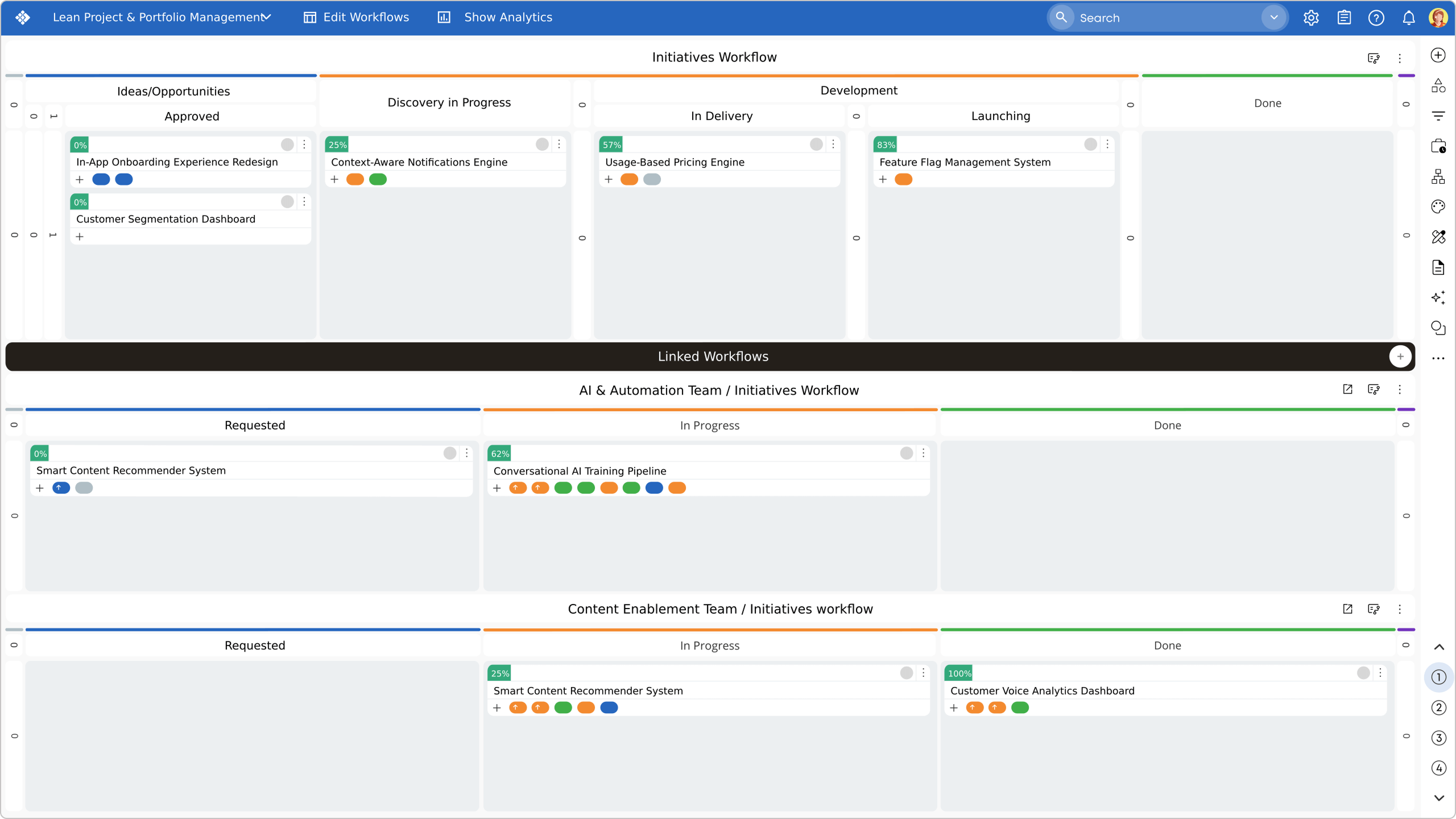 Breaking down initiatives and connecting them to individual team boards using a project portfolio view in Businessmap
Why Use PPM Scoring Models to Rank Projects
Basic scoring models are a common starting point in PPM prioritization, but many organizations evolve toward more dynamic approaches.
By assigning weighted criteria, such as ROI, risk, and alignment, organizations can compare initiatives consistently.
A high-scoring project may still need to wait if:
- critical resources are unavailable
- dependencies are unresolved
- timing conflicts with other initiatives
Effective prioritization combines scoring with context:
- capacity
- dependencies
- strategic timing
The goal is to assemble the most effective portfolio.
How WSJF (Weighted Shortest Job First) Improves Prioritization Decisions
While traditional scoring models provide a solid foundation, organizations adopt more advanced approaches to improve decision speed and economic outcomes. One of the most widely used methods is Weighted Shortest Job First (WSJF).
WSJF prioritizes work by comparing the cost of delay against the duration of the job. In simple terms, it helps answer: Which initiative delivers the highest value in the shortest time?
WSJF introduces urgency and efficiency into the equation. Initiatives that deliver faster results or prevent higher losses if delayed naturally rise to the top.
This makes WSJF particularly effective in environments where:
- demand exceeds capacity
- time-to-market is critical
- priorities shift frequently
The method is commonly used in Lean and Agile portfolio management because it balances value, urgency, and effort in a single prioritization model.
When applied within a PPM system, WSJF becomes even more powerful because decisions can be continuously updated as new data emerges, rather than recalculated manually.
PPM vs. Traditional Project Management for Prioritization
The difference between project management and PPM is fundamental.
Step-by-Step: How to Prioritize Projects Using PPM
A structured PPM approach follows a clear sequence.
→ It begins with defining strategic objectives. Without this, prioritization lacks direction.
→ Next, project data is standardized to allow meaningful comparison. This includes ownership, timelines, and expected outcomes.
→ Scoring criteria are then applied to establish relative value. From there, capacity is assessed to determine feasibility.
→ The final step is building a balanced portfolio - one that maximizes value within real constraints.
Unlike static planning, this process is ongoing. As conditions change, priorities are revisited and adjusted.
How Modern PPM Tools Enable Smarter Prioritization
Traditional tools struggle to support dynamic prioritization. Spreadsheets and static systems lack real-time updates and require manual reporting.
Modern PPM platforms solve this by providing:
- real-time portfolio visibility
- integrated data across teams
- visualized dependencies
- continuous reprioritization capabilities
This is especially critical in hybrid environments, where distributed teams require shared, up-to-date context to operate effectively. Security is equally important in remote collaboration, making it essential to equip teams with the right tools. Understanding how a VPN works and deploying dependable remote access VPN solutions ensures that all connections to project management systems are encrypted and protected from external threats.
Best PPM Tools for Enterprise Project Prioritization (2026)
Choosing the right tool determines how effectively prioritization can scale.
Enterprise platforms like Businessmap offer strong governance capabilities for large organizations. Agile portfolio tools such as Jira Align and Targetprocess focus on scaling team-level execution.
Businessmap differentiates itself by combining:
- visual portfolio management
- real-time strategy-to-execution alignment
- flexibility across Agile and traditional workflows
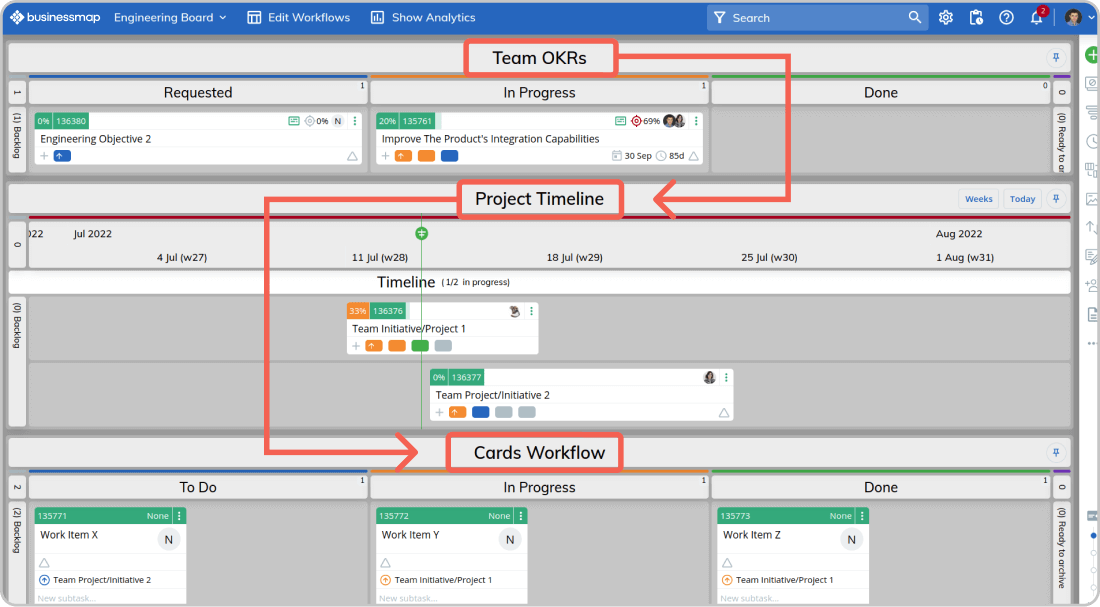 Connecting team-level priorities to project timeline and individual work items for a total visibility across all projects and portfolios
How Businessmap Enables Real-Time Project Prioritization
The real power of PPM lies in connecting decisions to execution.
In Businessmap, strategic goals are visualized and broken down into initiatives that link directly to team-level work. This creates a clear line of sight across the entire organization.
Teams can:
- track dependencies across workflows
- monitor portfolio health in real time
- adjust priorities based on actual progress and constraints
In one engineering case, this shift replaced fragmented spreadsheets with a unified system. The result was improved coordination and a nearly 30% reduction in product development cycle time. (Read the Full Case Study)
Explore how Businessmap supports company-wide goal alignment by linking strategic goals to initiatives, team objectives, and day-to-day work, all within a single connected system.
Common Prioritization Challenges (and How PPM Solves Them)
Trying to prioritize everything dilutes focus. Ignoring capacity leads to overcommitment. Static plans quickly become outdated.
PPM addresses these challenges by:
- forcing explicit trade-offs
- making constraints visible
- enabling continuous adjustment
- increasing transparency across decisions
These are not incremental improvements; they fundamentally change how organizations operate.
Learn how Businessmap connects strategy, prioritization, and execution in one system.

Iva Krasteva
Content Strategist | Agile Practitioner | Kanban Certified
Iva is a Kanban-certified Agile expert with hands-on experience in SEO, content creation, and Lean practices. She has published dozens of articles on Lean, Agile, and Kanban practical applications. Iva actively promotes collaborative, flexible work environments and regularly shares process optimization insights through writing.