Working with organizations scaling project portfolio management, we've seen where decisions quietly go wrong and it's rarely about budget. It's about misjudging cost.
Not because leaders can't afford the tool, but because they underestimate the total cost of ownership (TCO) and overestimate what entry pricing actually delivers.
This is where most PPM investments lose their edge before they even begin.
We'll break down real pricing benchmarks, hidden costs, and how to evaluate PPM pricing as a strategic investment in execution, not just a software expense.
Understand the 4 Core PPM Pricing Models First
Before comparing tools, you need to understand that pricing models dictate how your costs scale and not just how they start.
Per-User Pricing
This is the most common model. This type of pricing feels most predictable – you add users and multiply cost. At small scale, it works.
In enterprise environments where visibility across departments is critical and alignment requires cross-team participation, per-user pricing can quickly become a constraint, not just a cost. Ensure pricing scales with your needs.
Tiered Pricing (Feature-Gated Plans)
Most PPM software vendors segment their offering into tiers:
- Basic → limited functionality
- Standard → partial capabilities
- Pro/Enterprise → full access
In practice, this means that you are forced to upgrade not because you scale, but because you hit functional limits.
Enterprise / Custom Pricing
Some vendors offer personalized pricing for enterprise needs. The way that works is:
- You request a quote
- Pricing depends on your size, complexity, and negotiation
Enterprise pricing is based on perceived value and budget. Which means two companies can pay radically different prices for the same product based on their needs and use.
Flat or Bundled Pricing
Some platforms take a different approach, treating pricing as a configurable system rather than a rigid tier.
The Businessmap pricing is structured around user tiers with volume discounts, but extends beyond that. Organizations can adjust subscription models (annual, committed monthly, or flexible monthly), and layer in capabilities such as automation, API limits, or support packages depending on their operating model.
This means that pricing scales with how you work and not just how many people you add.
SaaS vs. On-Premise PPM Pricing: Which Is Better?
This question comes up in almost every enterprise conversation: Should we go SaaS or on-premise?
The short answer: SaaS wins in most cases.
What SaaS Actually Buys You
- Subscription-based pricing
- Continuous updates
- Faster implementation
- Lower upfront investment
But the real advantage is that SaaS reduces friction in scaling your operating model.
The Reality of On-Premise Costs
While on-premise gives you control, in practice, it introduces:
- Infrastructure costs
- Maintenance overhead
- Upgrade cycles
- Internal IT dependencies
- Overall slower decision-making
When your system is harder to evolve, your strategy becomes harder to execute.
Total Cost of Ownership (TCO)
This is where pricing decisions either hold or collapse. TCO includes implementation time, customization, training, support and maintenance. And in real-world transformations, the faster you reach value, the lower your real cost, regardless of subscription price.
Unlike static SaaS tiers, some platforms expose pricing variables directly, allowing organizations to simulate cost based on users, add-ons, and support levels in real time. This level of transparency changes how pricing decisions are made, from guesswork to scenario-based planning.
What Hidden Costs Come with PPM Tools?
If you only evaluate subscription pricing, you're seeing half the picture.
Implementation and Time-to-Value
Some enterprise tools require months of setup, or external consultants for complex configurations. Others deploy in weeks with lower overhead. That difference is both technical and financial because delayed implementation means delayed ROI.
Necessary Feature Upgrades
Many tools lock critical capabilities behind higher tiers:
- Advanced analytics
- Automation
- Integrations
You start small and then realize you need to upgrade to get access to advanced data insights, or integrations you need to run operations smoothly.
Integration Costs
Your PPM tool doesn't exist in isolation. It needs to connect to external ERP systems or BI platforms, and these integrations often require external support, or API knowledge.
Training and Adoption Costs
The most expensive PPM tool is the one your teams don't adopt.
Complex platforms:
- Require training
- Increase admin overhead
- Slow down onboarding
And that cost compounds across the organization.
Support and Success Services
One of the least visible but impactful cost drivers in PPM is support and its quality.
Businessmap, for example, structures support as part of its pricing model - from standard SLA to enterprise-level consulting, onboarding workshops, and dedicated success managers.
This matters because implementation success is an organizational challenge.
The more support is embedded into the pricing model, the faster teams reach adoption, and the lower the long-term cost of ownership.
One thing that really makes Businessmap stand out is their customer support. The team is quick to respond to my questions and provides detailed answers. They also take our feedback seriously and are open to suggestions for improvements. — Gartner Peer Insights Review
Scaling Costs
As your organization grows, more users, more workflows, more data, and costs increase exponentially. This is where pricing models either support growth or punish it.
What Features Actually Justify Premium Pricing
In platforms where core capabilities, such as analytics, workflow customization, and OKR alignment, are included without restrictive tiering, premium pricing reflects scalability and support rather than feature access.
Strategy-to-Execution Alignment
The ability to connect OKRs, portfolios, programs, projects and tasks in a single view in real time.
This is where tools like Businessmap differentiate, by making alignment visible and actionable across all levels.
The video below shows how OKRs can be aligned across teams and portfolios in a real environment - illustrating why alignment capabilities are often the deciding factor behind premium PPM pricing.
Portfolio-Level Visibility
Real-time dashboards that clearly show progress, risks and dependencies.
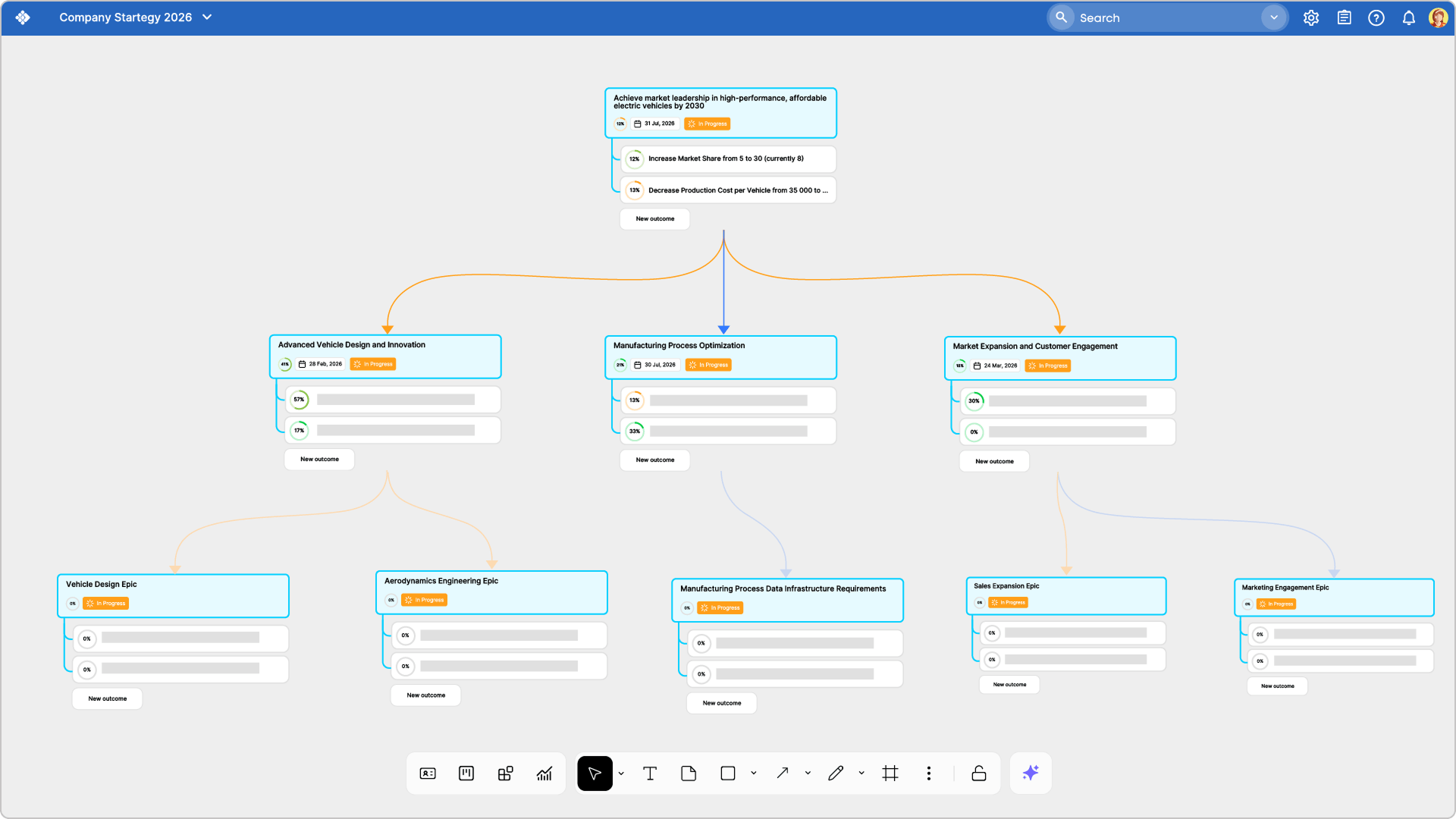 Visualizing how strategic goals, programs and portfolios connect using the AI Canvas board in Businessmap
Resource and Capacity Management
The difference between planning work and delivering it comes down to capacity visibility.
Advanced Analytics and AI
Modern PPM is no longer reactive. With flow metrics, forecasting, and AI insights, teams can:
- Predict delays
- Identify bottlenecks
- Optimize execution
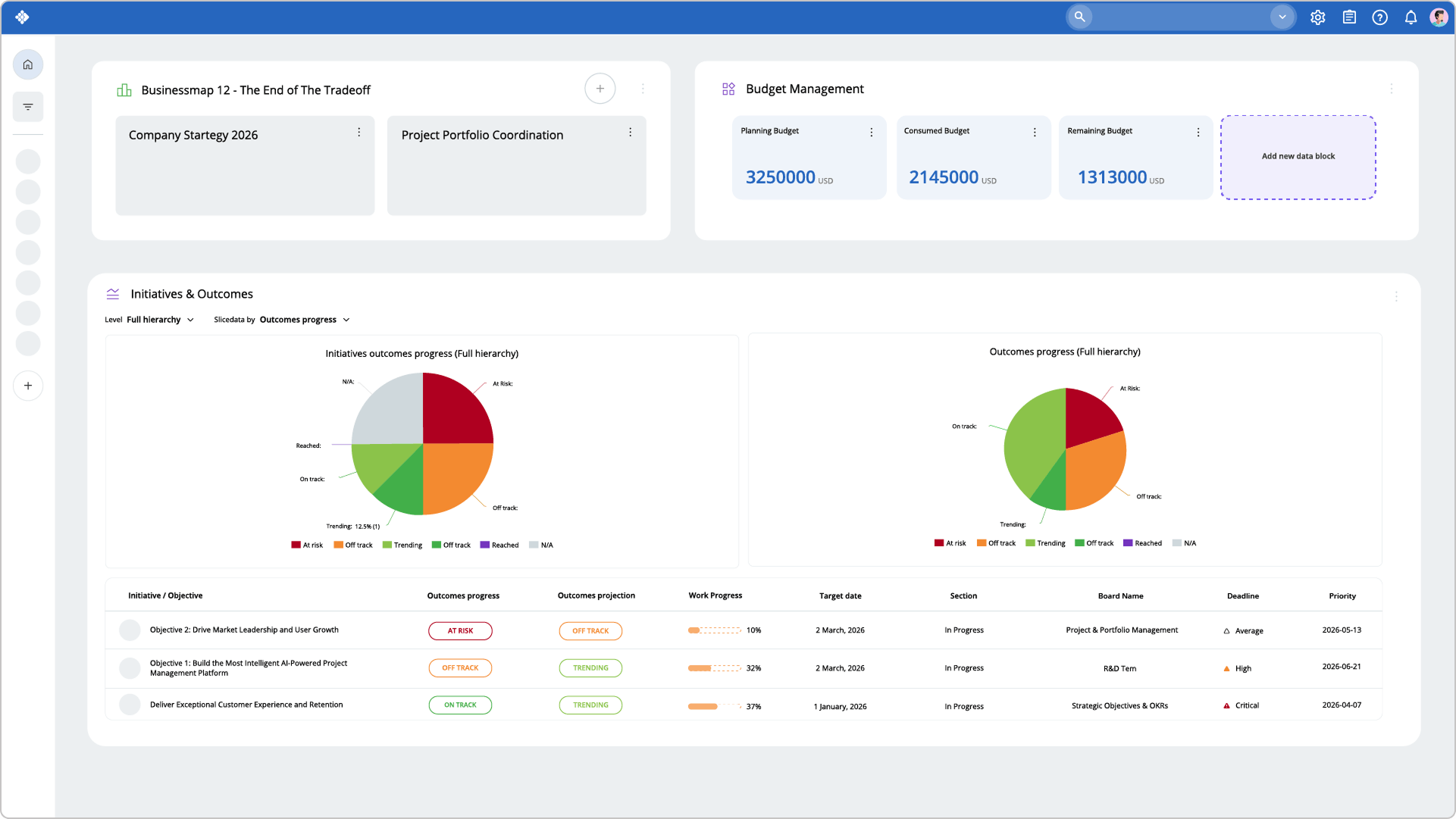 Monitoring objectives progress using executive dashboards in Businessmap
Workflow Flexibility and Scalability
Organizations need tools that support Agile, Waterfall, and hybrid models without forcing you into any specific structures.
How to Choose the Right Pricing Model for Your Organization
Teams often optimize for cost per user instead of cost of execution.
A Better Decision Framework
Evaluate pricing based on:
- Complexity of work (not just team size)
- Need for strategic alignment
- Integration requirements
- Growth trajectory
A Practical Insight
If your goal is to connect strategy with execution, prioritize:
- Visibility
- Adaptability
Because in PPM, cheap tools often create expensive outcomes.
Ready to Evaluate PPM Pricing the Right Way?
If you're comparing PPM tools, don't rely on pricing pages alone.
See how pricing behaves in practice:
- Explore how different models impact total cost of ownership
- Test what happens when you scale users, workflows, and integrations
- Evaluate how quickly you can move from setup → execution → measurable results
Explore Businessmap's pricing and see how it scales with your organization.

Iva Krasteva
Content Strategist | Agile Practitioner | Kanban Certified
Iva is a Kanban-certified Agile expert with hands-on experience in SEO, content creation, and Lean practices. She has published dozens of articles on Lean, Agile, and Kanban practical applications. Iva actively promotes collaborative, flexible work environments and regularly shares process optimization insights through writing.