Quick Verdict: Businessmap vs. Planview
If your organization needs a flexible, highly visual, AI-enabled PPM platform that unifies strategy, portfolio visibility, and execution without complexity, Businessmap is the stronger choice. It offers faster time-to-value, modern AI capabilities, a more intuitive UX, and end-to-end visibility that scales cleanly across portfolios, teams, and workflows.
Planview is a powerful enterprise solution with deep financial governance and scenario planning, but it often requires significant configuration, long implementation cycles, and heavy admin support.
Best For:
-
Businessmap → Organizations seeking fast adoption, real-time portfolio visibility, OKR alignment, hybrid workflows, and AI-assisted decision-making
-
Planview → Large enterprises needing strict financial governance, complex resource modeling, and scenario-based portfolio planning
Businessmap vs. Planisware: Side-by-Side Comparison
1. Strategy-to-Execution Alignment
Leading PPM platforms allow organizations to align strategic goals with execution by connecting objectives, business cases, portfolios, resources, and delivery workflows.
Businessmap offers an AI-enabled, helps managers define strategy and link strategic objectives (OKRs/KPIs), projects, deliverables, and tasks in real time.
Key alignment capabilities include:
- Multi-layer strategic boards (OKRs, initiatives, programs, portfolios)
- Automatic roll-ups of status, risk, and progress from execution to strategy
-
Flight Levels visualizations for cross-company alignment
- Real-time dependency visibility across streams
- AI insights explaining performance trends and alignment risks
→ Customer Insights: Businessmap customers report 80% improved visibility, reduced planning cycles, and dramatically fewer misaligned initiatives (Fortune 500 Energy Case Study↗)
Planview provides a structured strategic portfolio management (SPM) framework that connects strategy, investment funding, and execution.
Key alignment capabilities include:
- Enterprise strategy modeling and OKR tracking
- Roadmaps connecting goals to programs and investments
- Portfolio prioritization and value scoring
- Investment guardrails and strategic theme categorization
- Planning horizons for long-term strategy management
What makes Businessmap stand out
Unlike Planview, which often requires significant configuration to establish alignment models, Businessmap delivers out-of-the-box strategy-to-execution mapping that teams can adopt immediately without the complex portfolio architecture required.
Run projects. See portfolios. Deliver results. All in a single place.
2. Workflow Flexibility
Businessmap is workflow-agnostic and built for Agile, Lean, Waterfall, SAFe®, Flight Levels, hybrid, and custom models.
Workflow flexibility features include:
- Highly flexible board layouts
- Unlimited hierarchy levels
- Custom policies embedded into workflows
- End-to-end value stream mapping
- Service Level Expectations (SLEs)
→ Customer Insights: Organizations such as CTT Portugal achieved major reductions in delivery time (120 → 63 days) and improved flow efficiency by 55%, thanks to Businessmap's ability to support hybrid structures. Read the case study↗
Planview supports flexible workflows through configurable portfolio structures, custom forms, gated processes, and hybrid execution across Waterfall, Agile, and SAFe environments.
Workflow flexibility features include:
- Portfolio Kanban
- Demand management workflows
- Stage-gate processes
- Agile Program Management extensions
- Custom lifecycle governance
What makes Businessmap stand out
Businessmap excels in flexibility, providing fully customizable boards and letting organizations design Lean, Agile, hybrid, or waterfall workflows without requiring heavy admin support. This is especially valuable for enterprises modernizing their PMO, scaling Agile practices, or transitioning toward value-stream governance.
3. Portfolio Planning & Visibility
Businessmap delivers real-time, multi-layered portfolio visibility without needing external tools.
Portfolio visibility capabilities include:
- Portfolio Workspaces with program + project consolidation
- AI-native canvas boards for visualizing all portfolio aspects, from AI-assisted insights on strategy definition to full initiatives breakdown
- Timeline planning (interactive Gantt)
- Bottleneck detection with flow analytics
- Real-time risk, status, and dependency mapping
- Custom dashboards for executives, PMOs, and teams
Businessmap's visual reporting and dashboards require no coding, making it far easier to interpret than competitors' complex reporting modules.
Planview is strong in portfolio planning and financial forecasting.
Portfolio visibility capabilities include:
- Portfolio roadmaps
- Scenario planning & what-if analysis
- Resource capacity modeling
- Investment prioritization tools
- Portfolio health dashboards
- Workload and dependency heatmaps
These features are powerful for long-range planning, though requiring frequent reliance on consultants to maintain reporting structures.
What makes Businessmap stand out
Businessmap delivers this through multi-layer portfolio boards, flow analytics, timeline planning, and automated dependency visualization. Instead of static stage-gate governance, Businessmap emphasizes dynamic flow and predictability, using real performance data to guide planning decisions.
 Visualizing strategy definition, initiatives breakdown and dependencies on a Businessmap canvas board
4. Lean/Agile Support
Businessmap is built on Lean and Agile principles, making it ideal for organizations practicing SAFe, OKRs, Flight Levels, or hybrid PMO structures. Its analytics (cycle time, throughput, WIP aging, predictability) provide unparalleled insight into flow, bottlenecks, and risks.
Businessmap offers Lean portfolio execution that is native to the platform, not layered on top of traditional structures. This makes it a preferred choice for Agile enterprises, digital transformations, and companies using Flight Levels, scaled Agile, or hybrid project management work models.
Planview is rooted in traditional PPM governance, but as a PPM solution, it supports hybrid Agile, employing:
- PI planning features
- ART coordination tools
- Backlog hierarchies
- Agile execution integrations (Jira, Azure DevOps)
5. Financial Governance
Businessmap integrates seamlessly with BI and financial systems while intentionally avoiding unnecessary financial complexity in the work interface. It includes lightweight, pragmatic governance suitable for Lean Portfolio Management:
- Capacity visualization and resources planning Gantt charts
- Portfolio-level executive status dashboards
- OKRs for tracking and forecasting financial initiatives and results
It focuses on agility and decision flow, not heavy financial modeling.
Planview's deeper financial modeling is valuable for capital-intensive or engineering-driven organizations. This makes Planview a good fit for organizations that require rigorous financial oversight and auditability, but increases configuration complexity and TCO.
Monitoring the progress of outcomes and initiatives using executive status dashboard overview in Businessmap
Businessmap is the most flexible software
to gain full work visibility across teams & portfolios
6. AI Capabilities
Businessmap integrates AI directly into execution processes, offering:
- AI insights on flow, risks, bottlenecks, and performance patterns
- Intelligent explanations highlighting causes of delays or instability
- AI-native canvases that help teams design and adapt plans
- Predictive forecasting embedded in analytics
- Native MCP server integration with AI tools such as Cursor, Claude Desktop, Claude Code CLI and others, enabling automated governance workflows, intelligent notifications, and multi-tool synchronization
Planview's AI features are extensive and designed for executives:
- Conversational AI for portfolio insights
- Portfolio Intelligence (AI-based trend detection)
- Sentiment analysis from project updates
- AI-generated executive summaries
- Portfolio Planning Assistant
7. Implementation Speed
Businessmap deployments typically take weeks, thanks to intuitive configuration, ready-to-use onboarding tutorials, and Enterprise onboarding support. More complex PPM implementations, however, can take longer.
Planview PPM solution often requires longer and more resource-heavy implementations.
- Often requires a few months to implement
- Professional services are common
- Training is essential to use advanced features
8. Total Cost of Ownership
Businessmap offers transparent pricing, no module-based limitations, and minimal admin requirements. Its automation and AI-ready integrations significantly reduce operational costs over time.
Planview may introduce:
- High licensing
- High configuration cost
- Training needed
- Admin resources required
- Consulting often necessary
9. Ideal Customer Profile
Businessmap is best for:
- Portfolio visibility across business + IT
- Scaling Agile/Lean or hybrid delivery
- Undergoing digital transformation
- PMOs transforming toward value-stream and flow-based delivery
- Companies adopting OKRs, continuous planning, or Lean governance
- Enterprises wanting lower TCO and faster ROI
- Wanting strong customer support without added cost
Planview is best for:
- Heavy financial governance
- Mature PMOs
- Structured portfolio planning
- Org that can invest significantly in configuration
- Prioritizing scenario planning and investment modeling
Gartner Peer Insights Customer Experience
| Category |
Businessmap |
Planview Portfolios |
Planview AdaptiveWork |
| Evaluation & Contracting |
4.7 |
4.0 |
4.4 |
| Integration & Deployment |
4.5 |
4.0 |
4.4 |
| Service & Support |
4.9 |
4.0 |
4.5 |
| Product Capabilities |
4.7 |
4.1 |
4.5 |
| Overall Rating |
4.7 |
3.9 |
4.5 |
FAQs
Which PPM platform offers the best visibility across portfolios, teams, and strategic outcomes?
Businessmap provides real-time, end-to-end visibility from OKRs to team-level execution with intuitive dashboards and flow analytics. Planview offers strong portfolio visibility as well, but relies on more complex configuration and financial modeling to surface comparable insights.
Check more Planview alternatives →
Which solution is easier to implement and adopt across the enterprise?
Businessmap deploys in weeks and is easy for teams to learn, requiring minimal admin overhead. Planview typically requires months of configuration, training, and professional services due to its depth and complexity.
How do Businessmap and Planview compare in terms of AI capabilities?
Businessmap integrates AI directly into daily execution, offering predictive insights, automated explanations, and AI agents MCP server integration. Planview provides advanced AI for portfolio intelligence, sentiment analysis, and planning support.
Which PPM software offers a lower total cost of ownership (TCO)?
Businessmap provides transparent pricing, fast rollout, minimal admin needs, and no-module limitations, resulting in a significantly lower TCO. Planview delivers enterprise depth but at a higher cost due to licensing, configuration, and ongoing maintenance requirements.
Businessmap is the most flexible software
to gain full work visibility across teams & portfolios



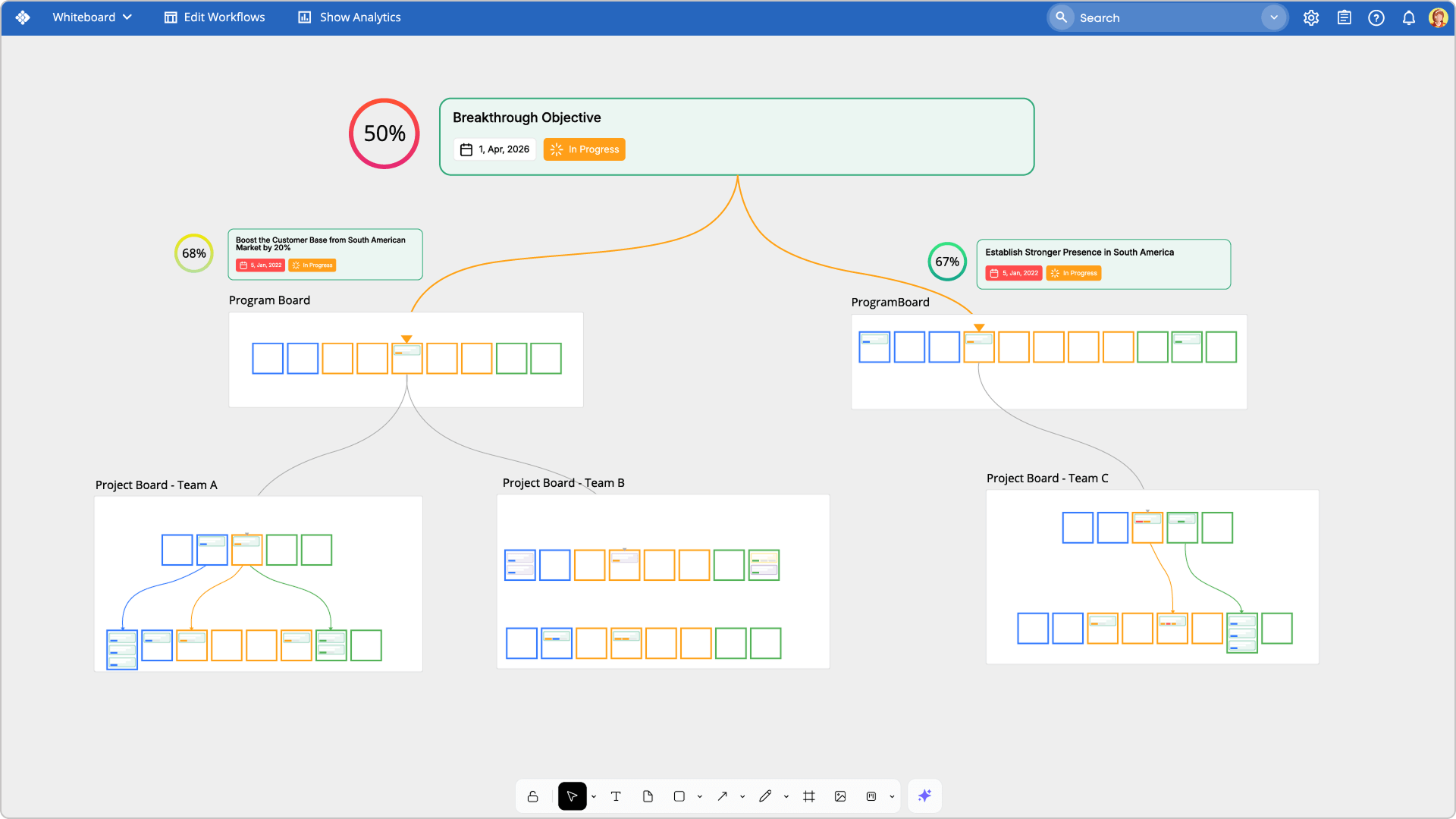 Visualizing strategy definition, initiatives breakdown and dependencies on a Businessmap canvas board
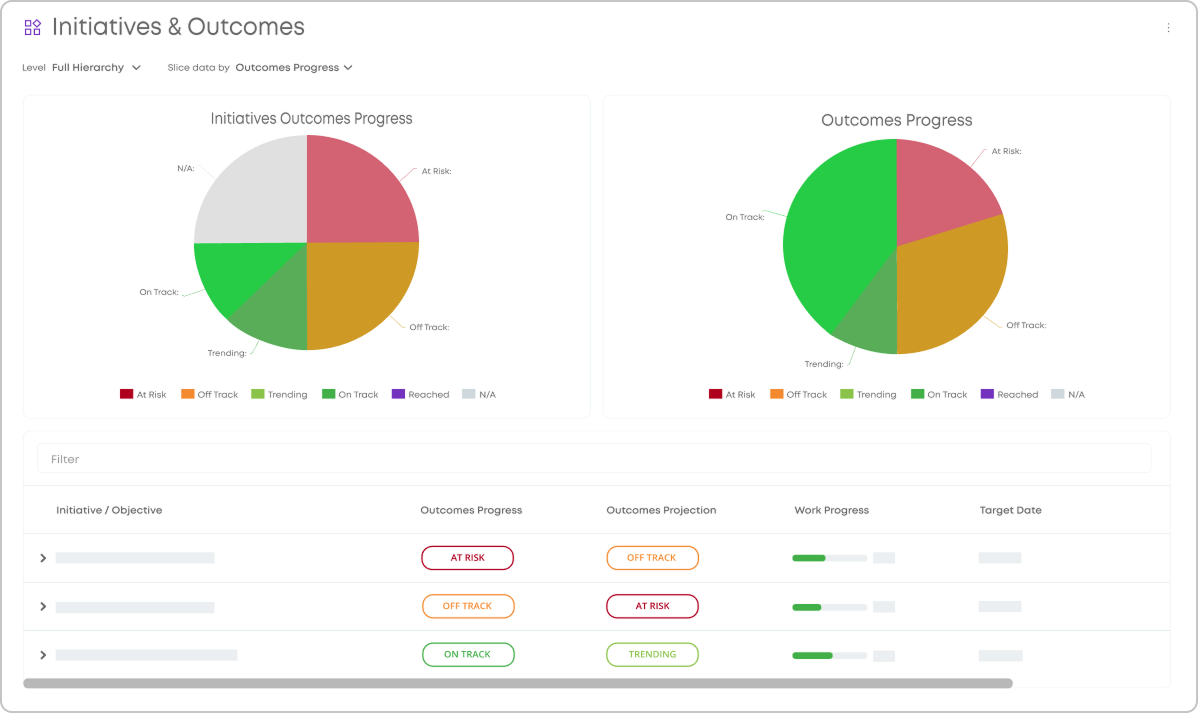 Monitoring the progress of outcomes and initiatives using executive status dashboard overview in Businessmap